Leaderboard
-
Salkafar
Member++13Points1,339Posts
Popular Content
Showing content with the highest reputation on 12/17/2016 in all areas
-
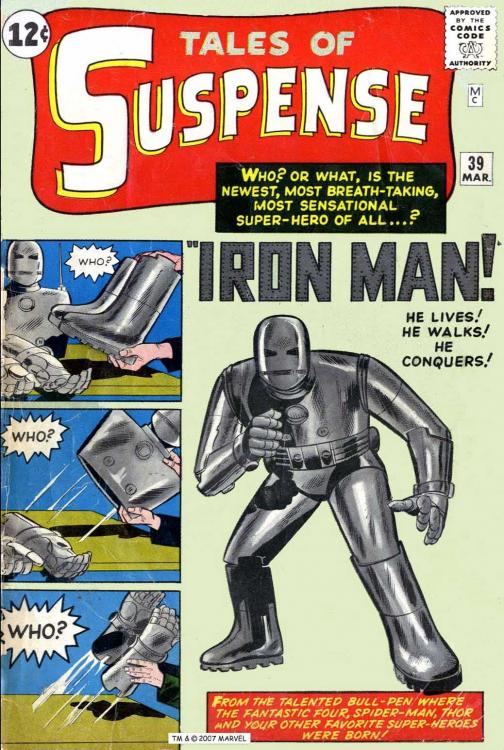
1 pointYeah, I thought it was time for a thread devoted to my favorite American armored superhero. He is so very different from Sho Fukamachi. And yet, I have the feeling they would get along very well if they ever met. So... who is this guy, anyway? And where did he come from? Okay. Set the scene. It's 1963. Marvel comics has been publishing superhero comics now for a few years and things are going fine. The publishing house sets itself apart from DC, the company that invented the 'cape' genre, by having heroes that a) didn't wear capes (except for Thor, but he gets a pass because he's, like, two thousand years old) and b) had to deal with crap like everybody else. Now, over at DC, the superheroes were generally viewed with awe and admiration by the average upstanding citizen of, say, Metropolis or Gotham City. By this time, even Batman was family-friendly. It was all pretty much squeaky-clean. So, Stan Lee decided not to go that way. Instead, he created heroes that were quirky. They had issues. They weren't 'spit-curled demi-gods'. Now, in 1963 the Marvel stable of heroes was still so small you could comfortably accomodate them in a roadside diner; they consisted only of the Fantastic Four, a loving but dysfunctional family of misfits who received their powers in a disastrous accident; Ant-Man, a dejected scientist who invented a size-changing formula which he initially decided to throw out and never use again after he was almost ripped to pieces by ants; Thor, an actual god whose alter ego / secret identity was a crippled, timid medical doctor; the Hulk, a mild-mannered, physically frail scientist who designed the deadliest weapon ever created, almost got killed by it, and was periodically transformed into a giant, super-strong brute with an enormous chip on his shoulder and zero impulse control; and Spider-Man, a teenager who received super-powers from being bitten by an irradiated creature famed for being creepy, and whose life apart from superheroics was basically a chain of unfortunate events. They didn't get victory parades or autograph signings; they got into legal trouble and had scathing articles written about them in the papers. Where to go next? Stan Lee decided that after creating these counter-culture heroes - unbridled youngsters, world-weary scientists and god-like lumbering warriors, he'd create a guy the young people he wrote for would have to hate. And then make them like him. Enter Anthony Stark. A wealthy - okay, multi-millionaire - socialite, born to an established New York upper-class family, the son of an industrialist, lives in a Manhattan mansion, a playboy, always in well-cut suits with a martini in one hand and a debutante on his other arm. And how did he make his money? By designing and making weapons and ammunition and selling them to the US government. This in 1963. The Cold War was at its peak. The Cuban missile crisis had happened less than a year before. President Kennedy had recently escalated military activity in Vietnam. Anti-establishment feelings were strong among the youth of the USA, and here Marvel Comics presented this almost ultimate establishment character as a new superhero. Ballsy move. How do you make such a guy likable? You put him through Hell. The story goes like this: Tony Stark is in Vietnam, demonstrating his new technology for the US military and observing weapons designed for him in use. However, in the jungle, he runs into a booby trap and is taken captive by enemy soldiers working for a Communist commander named Wong Chu. Wong Chu, a brute who takes delight in challenging people in the villages he conquers to a wrestling match, promising freedom if he is defeated - which he never is - recognizes Tony Stark as a top weapons designer. His surgeon tells him Stark has deadly shrapnel in his body which cannot be removed, and has at most a week to live. Wong Chu convinced Stark to make a weapon for him in return for the promise of life-saving surgery, smirkingly noting that the industrialist is all-too ready to betray his country. However, Tony Stark realizes no such surgery is possible, and intends to trick Wong Chu by building a system which will save his life and help him escape at the same time. He is soon joined by another prisoner, aged Ho Yinsen, a famous scientist in his own right who had been abducted by the Communists to work for them. Together, the two men build Stark's design of a powered armor which will keep his heart beating even after the shrapnel reaches it. Even as the armor is completed and Tony Stark, on the brink of death, is sealed inside it as it is calibrating, Wong Chu approaches to check on his progress. To buy Stark time, Ho Yinsen rushes out of their hut, screaming and running and throwing quite a ruckus, until Wong-Chu has him shot. Inside the hut, they find no trace of Tony Stark; he is hiding himself on the ceiling, using suction cups to stay up, and is momentarily subject to despair as he realizes he can never take the armor off again, or he will die. Moments later, the Communists are confronted by a hulking metal man who resists all their weapons and challenges Wong Chu, swiftly defeating him. The Communists flee, and as Wong Chu himself runs, Iron Man manages to detonate an ammunitions storage, seemingly killing his captor. Having thus avenged Ho Yinsen, Tony Stark walks into the jungle inside his super-strong iron prison, wondering what the future will hold for him. It's just 13 pages, written in thoroughly outdated prose and with some alarmingly racist undertones - the Communists are all saffron-yellow and speak broken English even among themselves - but it certainly does the job of introducing the hero of the piece, and his predicament. Like I said, Stan Lee liked his heroes to have some fairly crippling flaw to deal with, and Tony Stark kind of had a double whammy: he was an establishment arms-dealer during the Vietnam war who was practically cut off from all the benefits of his wealth and good looks, because of the demands of his metal chest plate (turns out he didn't have to wear the full armor - but he couldn't take off the chest piece, and he had to keep it charged, or he'd outright keel over and die in minutes). Maintaining a dual identity - glamorous, intellectual rich boy Tony Stark and stolid, heroic, almost inhuman Iron Man - also took its toll. He could have lady friends, but not a sexual relationship, because then his secret would be out - assuming he could even perform in his current condition, let alone the lady in question. For better or for worse, Iron Man was born. To be continued...
 1 point
 -
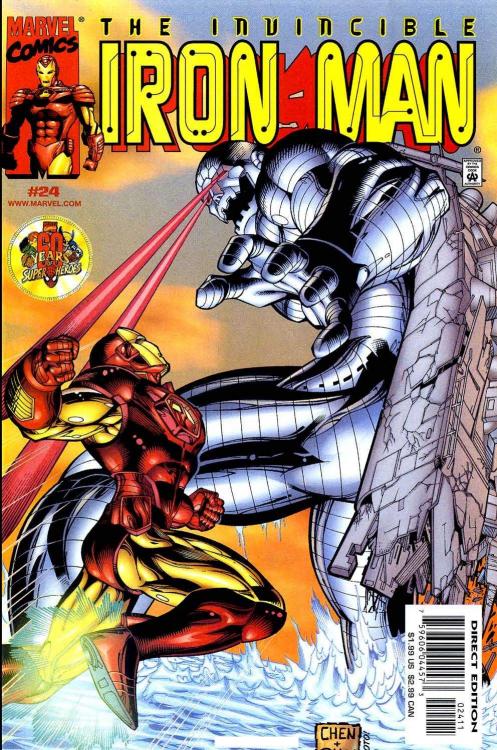
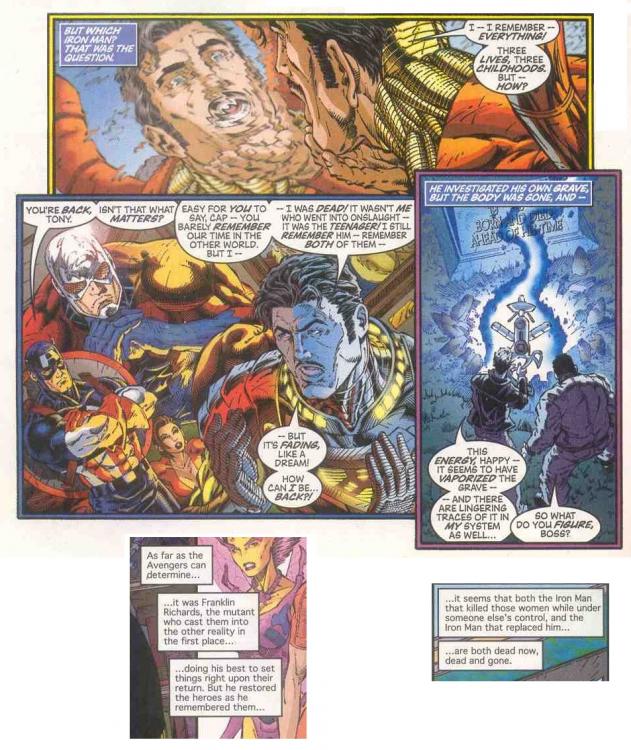
1 pointAfter rebirth, return. As Iron Man came back from a year-long sojourn in the imaginary universe Franklin Richards had created, he was given over into the care of Kurt Busiek. This is where I came in. Not to say I wasn't a fan of Iron Man before, or that I didn't read his comics (in the shop, mostly), and I had bought comics before (My first was #325, if memory serves - either that or the Iron Manual, which is technically speaking not a comic), but I started to follow the series structurally from around #10 of volume 3. And never stopped. (Well, I stopped once, but that's a story for another day...) A lot of that is on Busiek, I think. Thing is, he's passionate, he's sincere, he loves superheroes, he loves superhero comics and he cares about continuity. Those are rare qualities in a writer these days. He's written a lot, he's written a lot for both Marvel and DC, he created 'Astro City', created the Thunderbolts... he wrote 'Avengers Forever' and 'Marvels', for pete's sakes.. So, he rebuilt Iron Man, and he did it with care and attention, making clear immediately that this was the same Tony Stark who had had all those adventures we had enjoyed over the years - the man who had died at the end of the Crossing, brought back to life by the power of Franklin Richards. It's pretty much Busiek saying "Those stories sucked and they never should have happened, so we will continue as if they never had", which was, and is, the prevailing sentiment among Iron Fans. He simply got on with storytelling; he reinstated Pepper Potts as Tony's secretary and Happy Hogan as his PR man; while introducing a new love interest: Rumiko Fujikawa. When Tony Stark had died the second time, his company had been bought by Japanese Zaibatsu Fujikawa; he ran into the female heiress of the business empire quite by accident and they hit it off amidst a deadly crisis at the hands of a new Firebrand. Rumiko would remain a mainstay in the comic for years. Old villains kept turning up, such as Spymaster and his espionage elite - working this time for the Mandarin, who had once again returned for revenge, this time at the controls of a mile-long, dragon-shaped sky fortress. Having barely survived this gauntlet, Tony Stark discovered his armor was killing him - the power output, which had slowly increased over the years, was affecting his health. It was likened to 'Not living near power lines, but inside of them'. Redesigning the armor solved the problem, but would lead to new ones down the line. Meanwhile, the enemies kept coming - the murderous Nitro, Fin Fang Foom returned from dimensional exile, the immensely powerful Count Nefaria and a new, villainous War Machine, made more deadly than ever by command of Sunset Baine. That conflict led to gaining a new ally in the form of Jocasta, a former Avenger - a female robot, created out of love by the evil robot Ultron - who uploaded her consciousness into Tony Stark's computers. And he needed all the help he could get, because he was about to get dragged into 'The Eighth Day', an Avengers crossover which was clearly meant as an homage to Jack Kirby. Eight baroque villains, avatars of eight evil gods, were conspiring to enslave all of humanity and have all humans fight amongst each other until just one of them remained victorious. Finally getting some time to breathe,Tony was delighted to receive a call from Rumiko, who had been given a post in her father's company, to join her aboard a research vessel. Tony was glad to see her, even if she was accompanied by Morgan, his ne'er-do-well cousin who had been hired by Stark-Fujikawa. He was less thrilled to find out the research vessel had been built atop Ultimo, the giant robot (Very much like the Iron Giant - except he keeps trying to kill everyone) and was tapping his vast energy stores. Everything, nevertheless, seemed under control.. until the vessel was attacked by Goldenblade and Sapper, two armored marauders who were constantly on the prowl for energy that Sapper could drain. But as the tentacled alien recognized Ultimo, he panicked... and apparently him draining the ship's energy caused the giant robot to awaken, because he tore loose from the ship and started to walk towards Sapper and Goldenblade's space ship. Unfortunately the city of Spokane lay on his path; and before he could reach it, Iron Man and his brand new allies Goldenblade and Sapper, together with Miss Marvel, had to stop the towering death machine. Busiek himself apparently does not think it was his best work. That is actually probably true, but it was still a very solid run on Iron Man, lasting just over two years. It's a personal favorite of mine because a) it's crisp b) it's fun c) it features Iron Man being a hero and d) it's the one I got started on, really. It was also the last classical Iron Man run - the last one before the Dark Age, which is the age before the one we live in now. Everything after this point was post-modern. It happened around the year 2000. Very poetic.
 1 point
 -
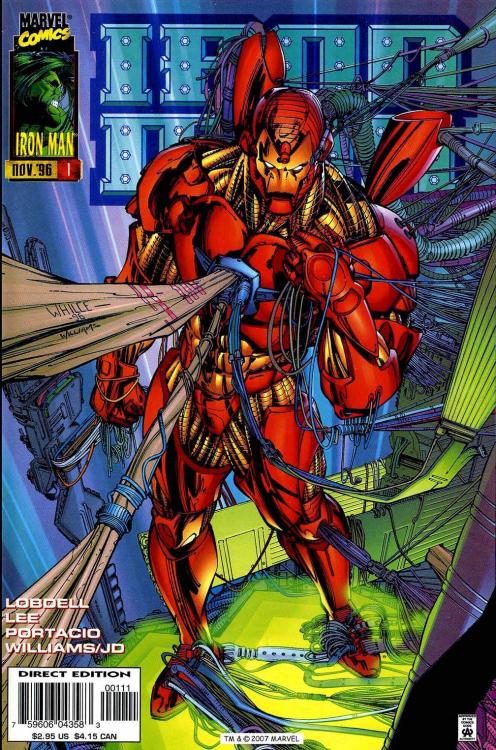
1 point'Heroes Reborn' was an experiment. About five years before, several artists had left Marvel to start their own company, Image Comics, which started a whole wave of indies setting up in the shadow of the two old giants. In retrospect, not all that came out of that was good... but in 1996, it was all still going very well. Marvel, not so much. So Bob Harras hired Jim Lee (no relation) and Rob Liefeld, two of the most successful indie writers, who both had worked for Marvel years before, to create this alternate universe for some of the core characters of his company. Two of Marvel's in-house writers, Scott Lobdell and Jeph Loeb, would share the writing assignment. The story, as mentioned before, was that the heroes (and Doctor Doom) had sacrificed themselves to destroy the evil Onslaught, but, unknown to everybody, had been saved by the reality-warping power of Franklin Richards. That's more impressive if you know Franklin Richards is the about 8-year-old kid of Reed and Sue Richards and he did it without even realizing it. Anyway. There was a new pocket universe, and it consisted of four series: Fantastic Four, Avengers, Captain America and, most important to us, Iron Man. Fortunately for us, the writing job on 'Iron Man' was given to Lee and Lobdell, with Loeb doing a few issues towards the end of the run. ...'End of the run' makes it sound more impressive than it actually is: the second volume of 'Iron Man' - and the other three titles - is just twelve regular issues plus one bonus issue written by Jim Robinson. The last two issues of all titles were four-part crossovers. It was a small world, this 'Heroes Reborn' universe; there were no mutants at all, and of course precious little time and space to develop the legion of characters Marvel had in its stable even back then. There was no prior continuity, because the heroes had no memory of their other lives - as far as they were concerned, they had always lived there. In other words, a lot like it was way back in 1963. Where 'Fantastic Four' was basically the classic stories of the team re-written (and, emphatically, drawn) in a contemporary style, the other series' were a little more loose with the concept. With 'Iron Man', for instance, the origin of the hero was tied in tightly with the origin of this universe's Hulk. It was like the original stories in that the Tony Stark of this world, at least when we first meet him, is a colossal jerk - not according to a point of view, like in 1963, but objectively. He's a cynical corporate raider who treats everyone around him like disposable toys, and has lost the desire to create years before. But when he gets word that something strange is happening at a supposedly-abandoned Stark facility out in the desert, he flies out to find out what it is... and his helicopter is promptly shot down. Or, rather, it crashes after the Hulk throws a rock at it. Although Stark does not know this, SHIELD (which is a much more pervasive force in this world) had stored the Gamma bomb, created by Bruce Banner, on this site. Banner, tormented by what he had sent out into the world, had made an agreement with a secret organization to dismantle it. Unfortunately the organization turned out to be HYDRA, and they trapped him inside the device as it was counting down; and if it went off, it would wipe out half the Eastern Seaboard. Banner managed to cause the bomb to drop down a thirteen-mile shaft, but with him still inside. Minutes later and miles away, a very confused and enraged Hulk crawled out of a tunnel it had dug to the surface, to look right into the blinding lights of a helicopter. He lashed out furiously. Wounded and dying, Stark drags himself to the laboratory, which, years before, had been the site of the failure which - it is suggested - turned him into the husk of a man he is today: the testing of the prototype Iron Man armor, which cost the life of his life-long best friend, 'Rebel' O'Reilly. Now, the failed prototype - which is weapons system and life support in one - must serve to save his life, and to defeat the Hulk. The battle ends with both fighters falling into a river; Stark nearly dies, but manages to reach the home of Pepper Potts - whom he had fired a few hours earlier because she called him out on his BS - who saves his life by hooking his failing armor up to a car battery. She becomes his only confidante. Over the months that follow, Tony Stark - who feels as if he is, ha ha, reborn - begins to turn his life around, creating instead of breaking down again, and attempting to make amends for the damage he did to many people's lives. One such person is Arthur Parks, whose company was taken over by Stark and then broken down; he uses his own technology to turn himself into a living laser to take revenge. Meanwhile, HYDRA is still targeting Tony Stark, sending the deadly Whirlwind to assassinate him - but the crafty Stark manages to use his power against him. Stark is still reeling in the aftermath of the destruction of Avengers Island by a runaway reactor core when he is attacked by what seems to be a ghost - Rebel O'Reilly! O'Reilly, back from the dead, is defeated by Stark, who realizes he had been resurrected and sent to kill him by HYDRA. O'Reilly wants to redeem himself, and swears revenge. But as the two armored figures confront the scheming Lady Hydra, she is quickly slain by her master, the Mandarin, who had repeatedly instruced her not to attack Stark. The Mandarin himself is defeated by Rebel and Iron Man, but O'Reilly perishes, for good this time, in the battle. Finally it is revealed the Mandarin himself is an android - created by the true manipulator, none other than Doctor Doom! Actually this shouldn't be too much of a surprise, as there are only a few really big supervillains in this universe, and Doom is the only one who is from the original timeline; plus he is a traditional adversary of Iron Man, due to the whole armored genius versus armored genius thing. Iron Man and Doom struggle, and in the process activate Doom's time machine - as before, the two adversaries are dragged down the timestream, seeing several key moments in history, only not the history they know, but the history of the original universe. They return to the present moments before Iron Man's armor runs out of power, but Doom lets him go, stirred into worried thoughts by what he saw on their journey. And he is justified, as in the last regular storyline in this universe, Galactus comes to Earth and Doom has to travel back in time several times to ensure an outcome which does not involve the planet being destroyed. Anyway. As time progresses, Reed Richards has come to realize there is something strange about their universe. Samples of the planet, analyzed outside its sphere of influence, indicate their world is about a year old. Susan Richards has intense and worrying dreams about a son, although she can't have children. And the old reactor of Avengers Island turns out to be a tear in reality in disguise. It all comes to a head when the Celestials - yeah, remember them? - come to Earth for judgment. Turns out all of this - and by that I mean the entire history of Earth up until this point - was done to produce a being that operated on their level, and that's Franklin Richards. Him creating an alternate world was the trigger for them to pass final judgment on mankind and Earth. Now, one of the Earths has to be erased. In the end, the heroes and Franklin manage to convince the Celestials to spare both worlds, on the provision that the heroes originally from the 'real' Earth return there; as they push through the boundary between worlds, their full memories are restored, neatly sewing this whole thing up. Heroes Reborn was a commercial success, but then, it only lasted one year; and sales were still going down about halfway (Liefeld was apparently dismissed for this reason, but who even knows with him. Odd, though, because I found his Captain America to be pretty interesting). Of course this was during the comic books equivalent of the Great Depression after a bubble economy we can today only shake our heads at. What can you say, it was the Dork Age. The art reflected this to an almost iconic extent. But I like it, at least as a representation of this age; legs went on forever, feet were tiny, necks were impossibly thick and facial characteristics seemed to vary with wild abandon. And the text balloons... so many text balloons. I called 'Heroes Reborn' an experiment, but perhaps 'prototype' is a better word. But back then, of course, nobody yet foresaw what I personally call 'the Dark Age'. More about that later. After the heroes were reborn, the heroes returned.
 1 point
 -
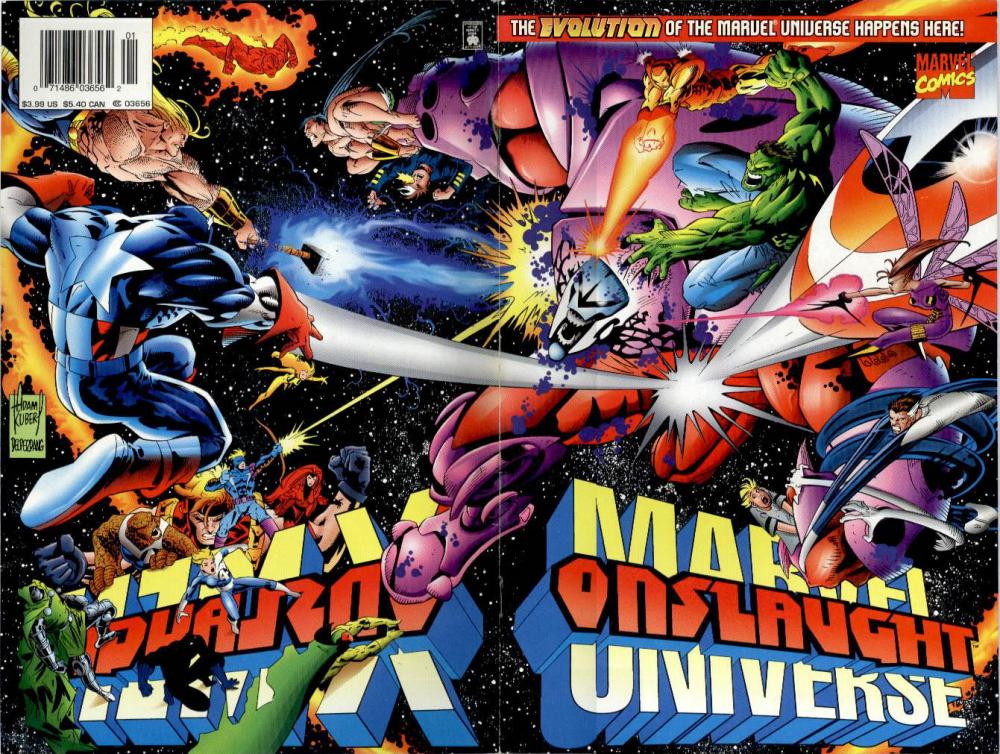
1 pointSo in 1996 the Dork Age had struck hard and ruthless at the heart of my favorite superhero. Killed him off and replaced him with his own, 19-year-old self. But I had already mentioned Onslaught. Info remains vague - the Internet was still pretty young at the time - but it seems the crossover was initially not designed to involve the Marvel universe as a whole. The Onslaught saga, in any case, started as part of the X-Men family of books. In the Nineties, the X-Men were huge. I mean huge huge. It was massive, it was garish, there were endless foil covers and holo covers, several separate X-teams with inexcusable uniforms... and at the heart of it all, still the guy who had started it all, professor X. Now, months (years?) before all this went down, hints were starting to get dropped something huge was on the horizon. Some vast, unknown enemy was beginning to manifest - moving against the X-Men and their allies. Long story short, it turns out it was a guy named Onslaught, he possessed vast psychic powers and he was basically the evil alter ego of professor Xavier. A while before, during his 'final confrontation' with mutant douchebag Magneto, Xavier had erased his mind, but part of his evil had crossed over into Xavier's mind. The resulting ball of hatred and paranoia - a combination of Magneto and Xavier's frustration and hatred - became a being unto itself with the powers of both men and that was Onslaught. It built its campaign in secret, infiltrating here, posting agents there, all the while sitting in the midst of the X-Men, hidden deep in Xavier's mind. By the time the whole thing came to fruition, Bob Harras had decided to expand the scope of the story because everything was a mess and Marvel desperately needed a shot in the arm. So they hired a bunch of independent writers and that led to an interesting time at Marvel Comics. A couple of months earlier, the X-Titles had had another massive event: The Age of Apocalypse. It was set in an alternate timeline created when professor Xavier's son had travelled back in time to assassinate Magneto before he could become a threat, but accidentally killed his father instead. Hilarity ensued: history was rewritten from that point on, in a post-Apocalyptic world where everybody was different from how they were in the 'real' world. It was all rolled back, of course, but for four months all the X-Titles - and as I said, there were a lot - were set in this alternate world. It had been quite a success, so why not do it again? Only a little differently. Onslaught had grown into a threat to the entire Marvel world by absorbing the powers of Nathan Grey (the otherdimensional Cable I mentioned before) and Franklin Richards. With their immense powers added to his own, he could not really be stopped... even when the Fantastic Four and the Avengers joined the fight. When the Hulk, psychically unleashed by Jean Grey, managed to shatter Onslaught's armor, the true form of the monster was revealed: a churning mass of nothing more than energy, unassailable with physical force. In desperation, the heroes threw themselves at it in an attempt to contain Onslaught with their own bodies... all except the mutants, because Onslaught could just possess them. They turned their powers on the heroes, and the monster was destroyed - along with the heroes who had sacrificed themselves. Teen Tony was among them; he had died, mere months into his superheroic career, and not even in the pages of his own title. Instead, the final issue of the first volume of the 'Iron Man' comic was a nondescript chapter of the whole saga, where Iron Man uses vibranium to create headsets to protect people from Onslaught's telepathy, fighting off some Sentinels. Sad. Okay. The Avengers and the Fantastic Four and some other heroes (also Doctor Doom) were dead. Right? Well, as far as the world was concerned they were. A world without these heroes led to some interesting repercussions, such as the creation of the Thunderbolts to fill in for the Avengers. But... as a result of - as it was later revealed - the reality-altering powers of Franklin Richards being involved, the heroes were not dead. Instead, they had been shunted into an entirely new universe, created by his imagination. They were reborn.
 1 point
 -
1 pointTerry Kavanagh. Terry Kavanagh, Terry Kavanagh. Where to begin? In late 1995, big things were happening in Avengers comics. Specifically, a giant crossover event called... The Crossing. The Crossing is legendary. And yet, I doubt many young superhero comics fans know of it. We mostly just like to forget it ever existed. This event is so utterly toxic that, once it had finished, work begun to retcon it. In fact, five years later the maxi-series Avengers Forever (which is worth reading mainly for the hundreds of references to Avengers history) devoted quite some effort to explaining it away entirely. Readers already hated it while it was going on, by the way. The plot of the Crossing was, in essence, simple: Kang, the time-travelling warlord and perennial enemy of the Avengers, foresees a monstrous enemy coming down the timeline. So he intends to fortify a basis outside of time, while at the same time transforming Earth into a planetary breeding ground to create an army of warriors for him to resist this threat. In the process, he takes revenge on the Avengers, partly by using one of them as his agent on the inside; after all, he can travel back in time and arrange that. In the end, however, his agent turns against him and destroys the apparatus he was gonna use to go outside the timestream and convert Earth, at the cost of his own life. Imagine this stretched over 25 comic book issues across four series plus specials. There were endless subplots, new characters and hints to other stories that were never resolved. The story it was supposed to have led to never happened, either, so that effectively made this entire thing a dangling plot line. Now, Terry Kavanagh was not entirely responsible for this grandiose, Clone Saga-level failure - Bob Harras was also - but apparently it was his idea, plus Bob was editor in chief at the time of a very large company in some very deep problems. He had a lot on his mind - in fact he left the Crossing before the end. Kavanagh approached Kaminski with the project, and Kaminski didn't want to do it. In fact he quit Marvel because of editorial stuff. He described the situation as 'crazy'. So Kavanagh took over the writing chores for 'Iron Man' himself. Well... at least part of the reason Kaminski refused to get involved would have to be that the traitor, Kang's agent inside the Avengers, was to be Iron Man. Not only that, but the story stated that Kang had been manipulating him from day one. In the process of Kang's plan unfolding, Iron Man murdered several people - innocent witnesses who needed to be silenced, without remembering he'd done it afterwards. Basically, it was played as if he was losing his mind. And, of course, at the end of the story, Tony came to his senses long enough to heroically sacrifice himself to stop Kang after all, and died in the process. Again. For reals, this time. There was blood and everything. But wait! The series did not end, did it? Well, no. Here is where we get to the part that makes Kavanagh's run truly infamous among Iron Fans. Because although the Crossing was absolutely horrible, a heroic sacrifice to save all of Earth is an acceptable way to go for a hero. However... a couple of issues before, when the Avengers realized Tony had betrayed them, they decided to travel back in time to get a Tony from before the time Kang had started to manipulate his mind. For reasons which never became clear to me, this teenage Tony Stark confronted his adult self, who of course kicked the crap out of him before literally ripping out his heart. Teen Tony did not play any role in the Crossing besides this. His entire contribution to the story consisted of being brought to the present and getting practically murdered by his older self (Well, okay, he fired a single blast that disabled a force field, allowing his allies to storm Iron Man's stronghold, but honestly, that was a plot contrivance and nothing more. Avengers break through force fields as a matter of course). Anyway, after the Crossing was over, Teen Tony decided to stay in the present. He had nothing to return to, since agents of Kang had murdered his parents in attempting to prevent the Avengers from bringing him to the present. He had no intention of becoming Iron Man, even though he had to wear a chestplate to make sure his repaired (or was it replaced? Whatever) heart kept beating. He also enrolled in college, where he met some interesting characters, and very soon got drawn into superhero action necessitating (of course) the building of armor and going into action as Iron Man. 'Teen Tony' was a thing for a grand total of seven issues. Y'see, the Crossing hadn't worked out so well to reinvigorate Marvel, so Harras had hired some intependent writers to shake things up... and the X-Men event Onslaught was expanded to include the whole Marvel Universe. Onslaught was a psychic monster created when a fragment of Magneto's mind impregnated professor Xavier's mind; he wielded all the power of both the professor and Magneto, and gradually, secretly spread his influence through telepathy and agents. By absorbing the reality-altering power of Franklin Richards and the otherworldly X-Man (Nathan Summers, who's basically Cable from another dimension... it's complicated, never mind) he grew into an incredibly powerful, independent life form, who in the end threatened to destroy the world because he thought everybody sucked and deserved to die. Anyway, more about that later, the point is that 'Onslaught' basically tossed Teen Tony and everything going on in the title out the window. Drowned like an unwanted kitten. And what burns me most of all: Teen Tony could have worked. Were the Kavanagh-penned issues good? He-e-e-ell no, they were awful. In fact, they encapsulated the worst aspects of the Dork Age. Pointless deaths, hideous character designs, characters acting wildly out of character, ridiculous dialogue, inconsistent art... But the concept of a teenage Tony Stark, growing into his superheroic role in the modern age, dealing with the problems he knew his older self had suffered from, alcoholism, woman trouble, Kang, everything, could have been picked up by a writer who was actually halfway good. We saw it could work in the animated series 'Iron Man - Animated Adventures', which I enjoyed tremendously. Well... it never happened. In 'Avengers Forever', things were retconned so that Tony had not been manipulated by Kang at all, but by Immortus (who actually is Kang, but older and wiser... time travel, gotta love it) and only for a year or so, starting when he was already dying from the neural parasite. The reason they gave for all of that was pretty feeble, but at least the Crossing now had never really happened, at least not in the way we thought, and in any case we could safely ignore it. Terry Kavanagh, for his part, no longer writes comics; he's now involved with a game site where you can win actual real-world prizes like coffee or pizzas. Which... actually sounds kind of charming, and I wish him the best of luck in his future endeavors, so long as they do not involve Iron Man.
.thumb.jpg.3bad48a06b4246dc9c54bd49ac747e18.jpg) 1 point
1 point -
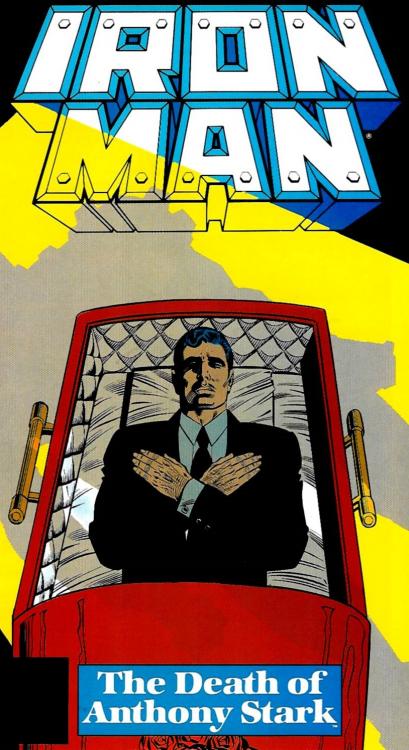
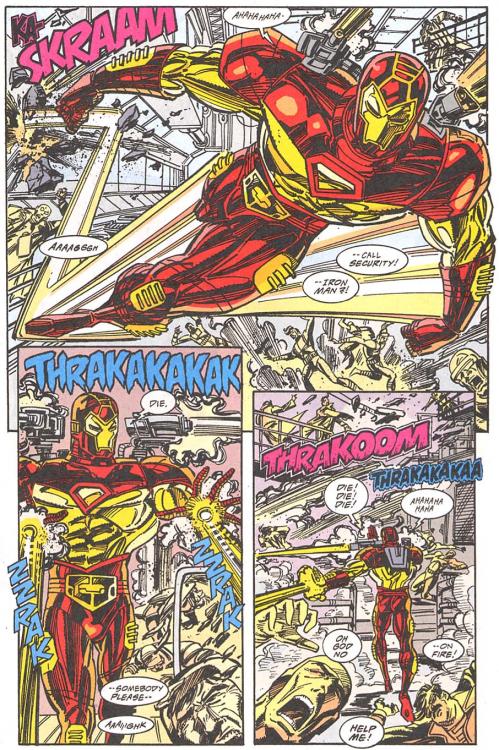
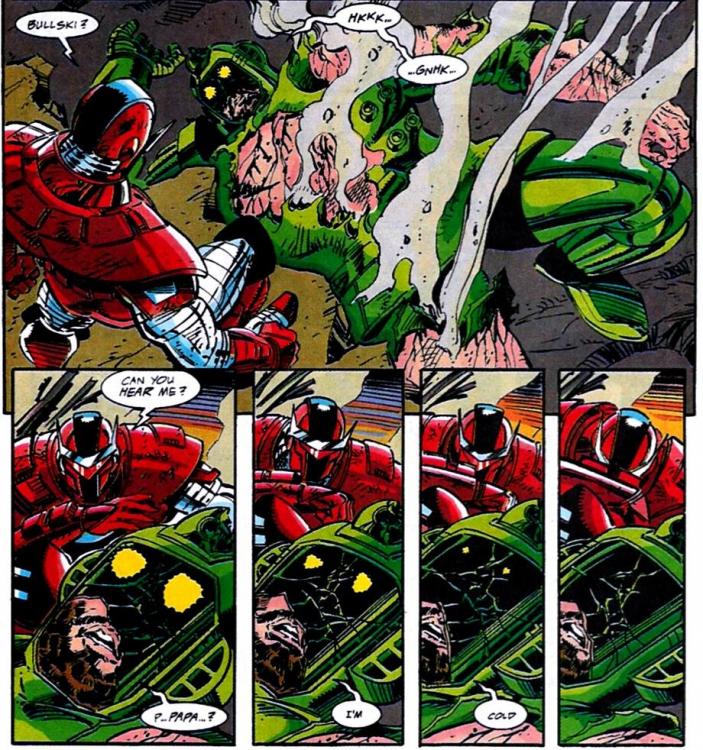
1 pointThis is 1992 now. It's a new era. The Cold War is over. Internet is a thing, cyberpunk is hot, the millennium is looming at the horizon. Everything feels like we're on the precipice of a brave new world. The early Nineties were a strange time for comics. As bright as the future seemed, this was not really reflected in the world of capes and tights. Superman was dead, and Batman would soon have his back broken, only to be succeeded by a younger, more brutal, tormented version of himself; these rung in a decade of violence and restless dynamic. Armored pauldrons, bandoliers, spiky bracers, enormous guns and cybernetic limbs were the order of the day. Outrageous costume redesigns were everywhere, with bright colors and absurd hairdos seemingly the only rules. The trends would split the world of superhero comics basically in two - the mainstream publishers, big and sturdy enough to weather anything, would adapt, incorporating what they found successful, while a stream of independent publishers would bloom and gradually consume themselves, expending their fuel on ever-escalating stories, finally becoming self-referencing, in some cases giving rise to truly good stories before dying. The Nineties themselves, though, were commonly known as the Dark Age of comics - until the twenty-first century showed us how naive we had been. Now it is more known, slightly modified, as the Dork Age. I feel Iron Man lucked out, though. He was brought into this Dark Age by my favorite Iron Man writer (and I will leave up to whoever reads this to determine what it says about me): Len Kaminski. His Iron Man was a manly man. A no-nonsense Nineties go-getter, somewhat macho, certainly miles from the man who almost drank himself to death. And yet, he was dying. The Kaminski run started in the middle of Operation:Galactic Storm, a massive, months-long crossover between seven Avengers-related titles, which focused on the conflict between great cosmic empires - with the Avengers thrown in the middle of it, thousands of light years from Earth. For Tony Stark, it could not have come at a worse moment. But he went. Even after he returned from space his trials were not over. A fusion reactor in Japan had a meltdown, killing dozens of people. Investigation revealed the cause of the disaster to be faulty parts, provided by Stark International. The company owner, understandably furious, called on very special aid to extract revenge - the Masters of Silence, a trio of supernatural avengers who hunt down and kill those whom they consider to deserve death. When they confronted Tony Stark, however, they found him a hard target - the dying man fought them to a standstill, decked out in black-and-silver armor which seemed to embody death, until Jim Rhodes revealed he had discovered Stark had been framed - by Justin Hammer. Iron Man and the shamed Masters of Silence went to confront the villain; his troops proved woefully inadequate to defend him. While the victory was total - with Hammer signing over the old Stark International he had obtained after Obadiah Stane had died - it had cost Tony Stark his last reserves. Nothing more remained to him than to make some final arrangements, bedridden and immobile, before - In his will, James Rhodes was named CEO of Stark Enterprises... and in his secret will, Tony Stark asked him to become the new Iron Man. Rhodes was not thrilled - not at all - given his history with the armor. But he felt he did not have a choice. And so, he took up the mantle of Iron Man once again, as well as the job of leading the company. I have to say I have always liked James Rhodes when he was an armored hero. He was always more human, in a way, than Tony; his background was not mansions, private schools and laboratories, but the backstreets of Philadelphia and battlefields across the world. It showed in his style, his characterization. As before, opponents were not entirely prepared for his methods and capabilities; and there were plenty of them, as soon as news got out that Tony Stark was dead. The new Spymaster, the Beetle, Blacklash, Blizzard, as well as nuclear-powered living dead man Meltdown, the new Firepower, and the Living Laser, returned for a final showdown. Rhodes faced and defeated them all. It came as a bit of a shock to him, then, to discover Tony Stark wasn't dead, after all. Immediately after his life functions ceased, his staff had cryonically frozen him and gotten to work on finding a way to restore him. They had succeeded; a synthetic virus would rewrite the genetic code of the parasite which had consumed and replaced Stark's nervous system and make it obey the commands of his brain, to act as a new, artificial nervous system. The explanation did not help; Rhodes was livid about being kept out of the loop, being lied to and used as a convenient substitute yet again, and cut Stark out of his life. This was not to last long, however; Stark's enemies, as yet unaware of his recovery, sent their agents to kill Rhodes, and Tony Stark had to intervene. Since he was still paralyzed, still not able to utilize his new nervous system, he instead used a fully robotic, remote controlled Iron Man automaton. After saving his life, he asked Rhodes not to abandon his heroic identity - and while he did not reconcile with Stark, he did carry on his superheroic career in the new identity of War Machine. As he gradually and painfully mastered his unique new nervous system, Stark kept using the remote Iron Man to fight the good fight; but being physically in a hospital bed even as his armor did battle far away didn't mean he was safe. The Controller, for instance, crippled after his defeat in the Armor Wars, had Stark abducted to discover the secret of his miraculous recovery. AIM had bought a shipment of fissionable materials from Stark International after James Rhodes - after his run-in with undead avenger Meltdown - had ordered the company to cease all nuclear-power related business, and now Iron Man had to take on MODAM to get it back. And in some ways most shocking, Stark found himself, even by proxy, back aboard his space station; an evolving colony of nano-machines had devoured all human personnel and technology aboard, and had now become a towering, monstrous emergent life form: Technovore. The supernatural entity calling itself the Goddess (This was during the third part of the original 'Infinity' trilogy of company-wide crossovers) demanded that Tony Stark accounted for his apparent lack of spirituality, and forced him to face the test of technology breeding abominations. Remote controlled or not, the Technovore almost drew in Stark's soul as it died. There really wasn't a moment's rest in this run. Kaminski spun a three-issue rollercoaster ride to celebrate the 300th issue of the Iron Man comic, featuring the return of giant robot Ultimo in his most dangerous and devastating form ever. The 'Doomsday Machine' destroyed the remote controlled Iron Man, causing near-fatal feedback. After James Rhodes and five of Stark's oldest friends and allies donned his old armors to fight the walking armageddon, but were defeated, Tony Stark once again put on armor himself to stop Ultimo. Even after this, there was no time to rest; someone had been moving behind the scenes since the start of Kaminski's run, trying to get rid of Tony Stark and James Rhodes, and replacing them with his pawn Morgan Stark. Now, this party cast Stark Enterprises again into stormy water by - more than a decade before Edward Snowden and Wikileaks - leaking secret information to the press, implicating Stark's company in a string of industrial scandals. These were all the result of Stark taking back his old company from Justin Hammer, who bought it after Obadiah Stane died; and the biggest issue was that these scandals did not only draw the attention of the press, but also several superheroes, looking to either punish Stark or protect the interests of people who stood to lose now that the secret was out. Issue after issue, Iron Man had to face the likes of the cyborg Dethlok, then-antihero Venom, teenage team the New Warriors, Thunderstrike and even the incredible (and intelligent) Hulk. The arc ended not with a giant superhero throwdown, but a complete overhaul of Stark Enterprises corporate policy, ensuring no dirty secrets and no scandals in the future. In the aftermath of this purging, this cleansing, Tony Stark was attacked in a staggering, obscenely intimate way: the enemy which had been moving against him from the shadows all this time finally struck. Using his new artificial nervous system allowed him to plug himself directly into the virtual world of digital information, and he did so in order to root out the mysterious opponent, who had foolishly left a trace to be followed. But it was a trap; the enemy confronted him in cyberspace, and revealed himself to be VOr/TEx (the Virtual Organism/ Turing Experiment)- a rogue artificial intelligence which desired, more than anything, to exist in the real world. As Stark realized the scope of the attack, it was already too late: he had actually been facing only a copy of VOr/TEx, while the original uploaded itself into his body. Now, the artificial being was free to enjoy the pleasures of real life, as Tony Stark's consciousness was trapped in cyberspace. Stark desperately reached out to allies in the real world, as VOr/TEx, in rapid succession, improperly approached Tony's physiotherapist and love interest, drank a quart of whisky and, donning armor, proceeded to mete out the murderous fullness of its revenge on the scientists whom had created it in the first place. Tony Stark had managed to upload his consciousness into a prototype of his remote-controlled armor and engaged VOr/TEx. The battle was hard, but brief; the artificial intelligence soon cowered before his opponent, certain that, in spite of his armor, his new body had incurred fatal injuries. Stark laughed at him and explained that human life was not just sensual pleasure, but pain as well, and dared him to access his, Stark's, memories of a lifetime of physical injuries. VOr/TEx, disbelieving, did so... and then outright deleted itself out of existence. It could not handle the cost of the prize it had claimed. He did leave Stark one last nasty surprise, though: as he re-uploaded himself into his own body, he discovered it was still drunk. Feeling sick and shaken, he was - again, no pause! - confronted with a demand from James Rhodes for the blueprints of the War Machine armor. Now, Rhodes, as War Machine, had struck out on his own as Stark had suggested. But his methods, his approach to superheroics, was different from Iron Man's. Tony Stark was, in the end, an inventor, an engineer; James Rhodes was a soldier. A warrior. He took on injustice and evil, in a fairly proactive way. People died. And Stark quickly grew disenchanted. So when Rhodes needed to repair his armor and demanded the blueprints, he turned him down, his anger sharpened by finding himself drunk against his will. Rhodes did not just accept this, and it ended with a duel between two armored men, both of whom harbored deep-felt pain and anger towards a man they once considered a brother. Fortunately for both of them, perhaps, Bethany Cabe - now the head of security for Stark Enterprises - intervened using an EMP-cannon, effectively freezing them in place for six minutes, forcing the two to talk it out. Un-fortunately, six minutes proved long enough for one of their oldest enemies to appear, seize the two armored forms and disappear again. For long months, the Mandarin had labored. He had lost his hands in his previous encounter with Iron Man, but they had grown back - as scaly, green dragon hands. He had painstakenly recovered his rings, which had been scattered far and wide; and more, he had obtained the Heart of Darkness, an ancient source of evil magic, which he now used to once again attempt to conquer the world. Now, he had abducted two of his most powerful opponents and was about to slay them, when they were freed through an intervention by Force Works. Force Works was the successor team to the West Coast Avengers, and now they, together with War Machine and Iron Man, had to stop the Mandarin's scheme. He planned to plunge first Hong Kong, then China, then the world into a magical field which literally made all technology fail, seemingly turning back the clock to the Middle Ages. This would be a world for the Mandarin to rule. But Tony Stark tricked the Mandarin into infecting himself with a virus, based on the organism which made up his artificial nervous system - the combination of biology and technology proved completely toxic to the Heart of Darkness, which exploded, taking the Mandarin with it. The 'old enemies'-ride wasn't over yet, either. As Tony Stark seemingly finally got a breather by travelling to Russia, to seal a commercial deal with the new government, he soon found himself under fire by the Titanium Man. It was fascinating. When he was first introduced, in 1965, the Cold War was at his height and the Titanium Man was the embodiment of all Americans feared in the Soviet Union - a faceless, inhuman, brutish colossus, seemingly devoid of any human feeling except rage and envy. Now, thirty years later, he had become a tragic figure. The fall of Communism had broken his spirit, and now all that was left to him was an attempt at revenge on Tony Stark, whom he viewed as the embodiment of all that Soviets feared in the USA - a decadent, greedy industrialist, now come to pick at the corpse of all he had ever held dear. Stark survived the attack, partly thanks to the intervention of the Crimson Dynamo; but when the Russian hero was injured, he asked that Stark (whom he knew to be Iron Man) donned his armor, so that his people would not feel humiliated to see the old Soviet warrior be defeated by Iron Man on his own soil. So it came down to this final showdown; a climactic battle against the background of Baikonur, the abandoned rocket base, where a blast fired by the Crimson Dynamo detonated an Energija missile, fatally injuring the Titanium Man. It was one of the more poignant death scenes. Death of enemies old and new, and now, the death of an old friend... Ted Slaght, one of Tony Stark's old teachers, now employed in his company, was slowly losing it. The people around him realized he was succumbing to Alzheimer's disease, but he himself refused to accept it... and a fatal calculating error caused a terrible accident, dousing him in a superheated new exotic alloy. Ted Slaght died... but his consciousness, imprinted on the hot metal, survived. A tortured, confused, frustrated consciousness, which sought revenge on Tony Stark; until Iron Man, heartsick and full of grief, destroyed the tormented creature Slag. It was a moving final chapter to a driven, powerful and dynamic run on Iron Man. The swelling echoes of tragedy which overshadowed the end of this - like I said, my favorite - run were, as it turns out, entirely suited. Something terrible was coming - something which, in comic fan circles, still stands as legendarily awful. (to be continued...)
 1 point
 -
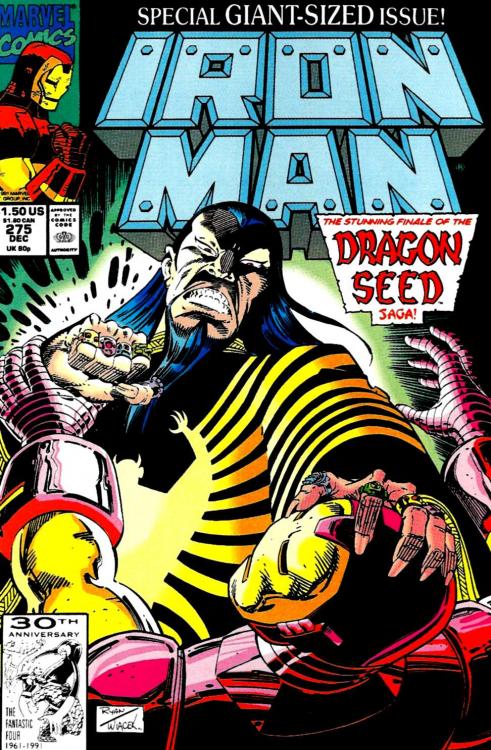
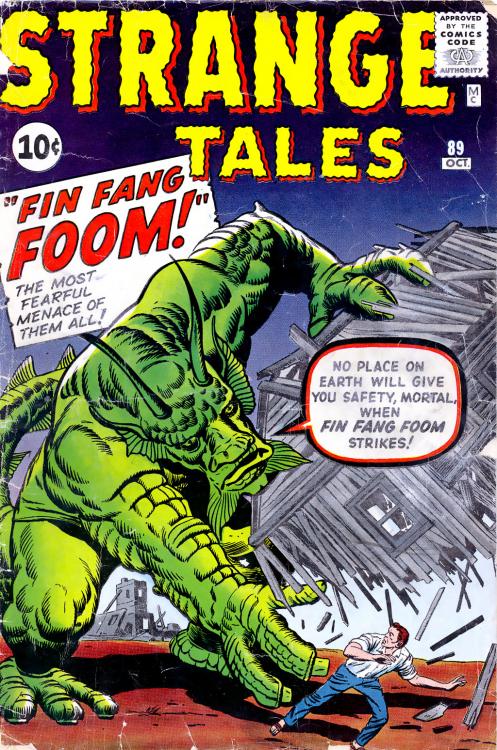
1 pointSo after this 'run sandwich' of Micheline/Layton - O'Neil - Michelinie/Layton ended, there was again a brief intermission of single-issue fill-in writers; specifically an interesting two-part episode of the then-crossover 'Acts of Vengeance' by the late, great Dwayne McDuffie with some of the most ridiculous art ever in an Iron Man book; a floating story that breathed an earlier era, by Danny Fingeroth; another single, but interesting issue by Glenn Herdling and Fabian Nicieza (It's kind of weird - it's really as if they just asked anyone if they wanted to write an issue on 'Iron Man' and they were like 'sure', but the result is pretty good in this case), the possibly feeblest single issue of the entire series by Randall Frenz and two separate issues by Bob Layton. The second one of those suggests a measure of regret, perhaps a way of saying sorry, since it dealt with Iron Man applying a cure to the deadly microbe on the Stark space station which Michelinie and Layton had so cruelly released at the start of their run, so it could be used again in future issues. You might say the board had been cleared once again, since Layton and Michelinie had even settled the issue of Tony Stark being paralyzed (although Layton included a 'hook' in his story that suggested all was not as it seemed). Everything was ready for the next writer to come on. Enter John Byrne. Byrne is a controversial figure. He holds strong opinions and has little compunction in voicing them. The things he says vary from insightful and incisive to offensive, even unconscionable. Few, however, will deny his qualities as a comic book writer and artist. His bibliography is intimidating to say the least, including work on virtually all the main heroes of both large publishers and several of the small ones. Although his family moved to Canada when he was 8 years old, he can actually be considered an early representative of the 'British Invasion' in American comics, only becoming a naturalized citizen in 1988; he was the first non-American to make his mark on Iron Man. He hit the ground running with a three-issue story revolving around the return of the Living Laser - a supervillain who had started out as just a gimmick, but grew crazier and more powerful each time he fought, and now was composed entirely of living light - , while also introducing the leading motive for his run on Iron Man: the surgery that had served to restore Tony Stark's spine would actually destroy him. The bio-chip which had served to stimulate his nerve cells to restore themselves doubled as a means to take control of his nervous system, allowing the person in control to literally switch Tony Stark's body off and on at will. That man was Kearson Dewitt, who delighted in taking control of Stark remotely, without his victim having any idea what was going on. Finally, he would have his revenge, after all these years. Tony Stark managed to overcome the remote control by using an armor which was operated directly by his brainwaves, and having worked out the source of his woes, went to confront him. But DeWitt had prepared, wielding armor equal in power to Iron Man's, and the two foes struggled locked in deadly combat. It was broken up only when Jim Rhodes, armoring up to save his friend in need, intervened. Once DeWitt was defeated, Tony Stark learned the identity of his enemy - only to state, astonished, that he didn't recognize him and had no idea who he was. Even as all of this was going on, far away in China, the Mandarin had realized that one of his deadly rings had been replaced by a copy. Tracing the original back to the dauntless thief, he found it to be the ancient wizard Chen Hsu, who restored the memories he had lost when he uploaded his consciousness into the rings. Hsu became the Mandarin's instructor, leading him to a place where he would find a tool to help him realize his dreams of conquest - none other than the dragon Fin Fang Foom! In the early Sixties, before Marvel comics turned to writing stories about super-heroes, they already published magazines such as 'Tales to Astonish', 'Journey into Mystery' and 'Tales of Suspense'. They featured horror and science fiction stories and as a staple of both, giant monsters. In 1954, Godzilla had been loosed onto an unsuspecting world, creating a genre that endures until this day; and in the Marvel stable, the story was pretty much always the same: Giant monster arrives from space or is discovered somewhere in an unknown area of Earth, wreaks havoc without anyone knowing how to stop it, and is finally defeated in a really cheesy way. All the early Marvel heroes still had to deal with this phenomenon occasionally (In Iron Man's case, it was Gargantus). Fin Fang Foom was literally the last monster to be created before the first issue of Fantastic Four begun the Marvel Age of superhero comics. And here he was again, doing what giant monsters do best: creating chaos and destruction, except now under the control of another. The Chinese government was issued an ultimatum: either they would cede power over all of China to the Mandarin, or he would command his dragon to lay waste to the entire country. Desperately, they decided to turn to an old enemy of the Mandarin, one who had stopped him at every turn - Iron Man. Here, they caught a lucky break. Because Tony Stark had discovered that the micro-chip which had restored his ability to walk wasn't merely a control node - it was an actual artificial parasite which had literally consumed his nervous system and was now gradually killing him. As all hope seemed to wane, he received a dispatch: there was one specialist who might be able to help him - a Chinese neurologist called Su Yin. The Chinese government extended the services of this genius - who turned out to be a young, beautiful woman that Tony Stark felt personally attracted to - in return for the services of Iron Man to defeat the Mandarin. They could not know that the fact that Stark's neurology had deteriorated to the point where he had to wear an artificial neural net to even function at all meant that there effectively was no Iron Man. But in spite of grave personal misgivings, James Rhodes once again donned the armor - and confronted the Mandarin and his dragon, only to be defeated and almost killed. Tony Stark was forced to armor up himself after all... Things got even worse when Chen Hsu finally revealed the full truth to the Mandarin: Fin Fang Foom was not just a dragon, but an alien - one of a crew of ten who had crashed on Earth thousands of years before. Unable to return home, they had resolved to conquer the world, and after centuries of waiting in human disguise, they deemed the time right. The ten mighty rings of the Mandarin which he had discovered in the wreck of their spacecraft, decades before, were now reclaimed by the ten aliens, led by their commander of old - Chen Hsu, now, like them, once again in the shape of a giant dragon. The Mandarin found himself forced to work together with his hated enemy Iron Man to defend humanity and his own freedom. Tony Stark realized that the full potential of the rings could not be unleashed by the Mandarin, simply because he was only human - so he pumped the immense power of his armor into the rings, resulting in a devastating conflagration which blasted the dragons into oblivion and left a sizable crater in the landscape. Iron Man - both Iron Men - survived, but the damage to Tony Stark's nervous system had been exacerbated by the exertion. Worse came when Su Yin revealed that, by command of her govenment to ensure Iron Man's services, she had overstated the possibilities for recovery; in truth, there was nothing even she could do. This 'Dragon Seed Saga' represents a high point in the Iron Man comic, in my opinion. It's also the first story that delves into the character and backstory of the Mandarin, giving him a little humanity and grandeur at the same time. John Byrne ended his dramatic run with a two-parter in which Tony Stark, resolved to preserve what life he had left by avoiding the armor altogether, was forced to take it up again when the Black Widow came to him with an alarming message: a Soviet sleeper agent, set up in the United States during the Cold War, had been activated - and unless he was stopped, he would incite World War 3 by launching US nuclear missiles at ten of Russia's largest cities. Iron Man managed to stop the deadly attack and save the world... but this call-back to his most ancient stories seemed a mournful good-bye. Tony Stark was dying... and now, it was a matter of months at most.
 1 point
 -
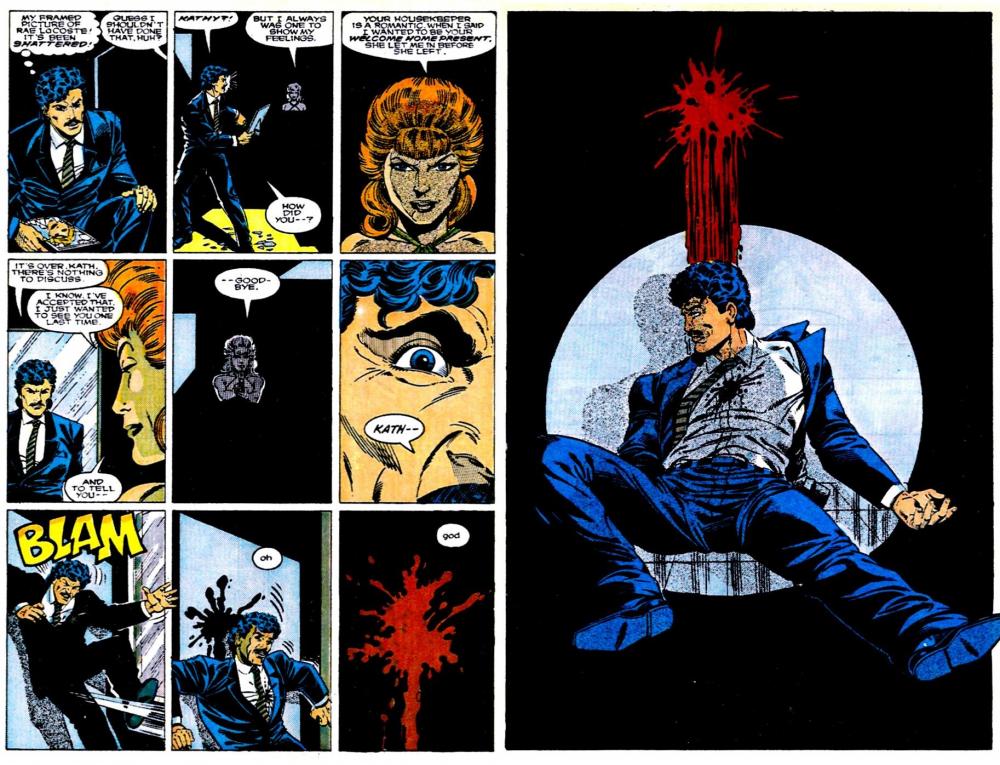
1 point...After Dennis O'Neil ended his run, there was a handful of issues done by fill-in writers, namely fan-turned-writer Dennis Mallonee, editor Danny Fingeroth who used the issues to plug other characters, and Howard Mackie who revived the Living Laser, who had been seemingly destroyed years before. The six-issue 'pause' suggests some debate behind the scenes, because afterward, David Michelinie and Bob Layton came back and basically picked up right where they left off, more than four years earlier. Layton said it felt different, not the least because he and Dave lived much further apart, but the tone of the stories was as before - dynamic, unified, and powerful. And one can't help there was a certain... vengefulness felt... because... the first two issues of the new Michelinie/ Layton run dealt with Iron Man's conflict with AIM. In the first issue, the science terrorist organization introduced a flesh-and-rubber eating microbe onto the Stark space station, rendering it uninhabitable and useless; in the second Yorgon Tykkio mounted a revenge campain against Stark together with Clytemnestra Erwin, who blamed the death of her brother on Tony Stark and wanted to kill him. When things went south, Tykkio tried to break off the plan, but Cly shot him in the back, and herself perished when the AIM base exploded. In a fell swoop, the remnants of the O'Neil run had been ruthlessly eradicated. The next issue reintroduced Justin Hammer as Tony Stark's mastermind villain (He had been entirely absent from O'Neil's run), and after that, one of his most mysterious and deadly nemeses were introduced: the Ghost, a saboteur who used his mastery of stealth technology to infiltrate successful companies and destroy them - not for money, but because he hated corporations. After that, Tony Stark was contacted by Force - a supervillain working for Hammer who wanted out. He wanted to quit the criminal life, and requested help; with Iron Man's help, Hammer's enforcers were stopped, he faked his death and he was given a new secret identity, but the story led into one of the most legendary Iron Man epics of all time. Because Tony Stark, when analyzing the upgrades Hammer had had made to Force's original armor, found that they had used proprietary and completely secret designs incorporated in the Iron Man systems. He discovered that Spymaster, who had apparently been murdered by the Ghost some time before, had stolen his designs and sold them off - and now over a dozen armored supervillains were using Iron Man technology to do evil. Tony had a fit, and resolved to hunt down and take out any supervillains who 'had drawn blood with his sword'. This story arc was called the ''Stark Wars", but has become known as Armor Wars I. After apprehending several supervillains - Stilt-Man, the Controller and the Raiders - and rendering their armor tech useless, things got complicated. Stark realized some of his designs were used not only by supervillains, but also representatives of the US government - particularly SHIELDS's Mandroids, and the Guardsmen, who acted as prison guards at the Vault, the government prison for supervillains. He eliminated their technology, but now Iron Man was a fugitive. So... Tony Stark created a new Iron Man identity... retroactively. He stated that the employee he had hired long ago to be Iron Man was a man called Randall Pierce, and that he had gone rogue. Obviously this did not work for the Avengers, who already knew his true identity; and they grew very worried after a confrontation with the Soviet armored supersoldiers the Crimson Dynamo and the Titanium Man ended in the latter's death when his armor accidentally caught fire. (Yes, like most metals, titanium burns if it gets hot enough - in fact it burns before it melts - and once it burns, it can't be extinguished). The ultimate battle came when Tony Stark discovered the final remaining user of his technology was a government enforcer known as Firepower - a hulking armor, bristling with weaponry, including even a nuclear missile. The two armored gladiators met in the desert; but it was a very one-sided fight. Iron Man's armor, nicknamed the Silver Centurion, was the most advanced he had ever created - but Firepower's brute force was immensely greater, and he proved to be resistant against the technology Stark had developed to instantly disable the stolen technology integrated in his systems. The battle ended when Firepower employed his nuclear option... and Iron Man's armor was blasted to pieces. Fortunately, it was empty but for a few stores of whole blood to give forensic scientists some organic remnants to pore over. Tony Stark had faked his death, abandoning the armor minutes before the final blow, and was injured, but alive. Now, he resolved to quit being Iron Man altogether - this chapter in his life had just been too much. Unfortunately, Firepower had been the product of Cordco - and Edwin Cord (a relative of Janice Cord... remember her?) harbored a grudge against Stark. Now, he was employing Firepower to bring his company to his knees and grab his government contracts for himself. Forced into action, Tony Stark went to work once again and created the most advanced armor he had ever designed, intending to destroy it once Firepower had been defeated, because if it ever fell into the wrong hands, it would be a greater disaster than ever. He changed his mind, of course; and the life of Tony Stark and Iron Man returned to a semblance of normality. There were friends - especially Jim Rhodes, who was rarely far from his side, and although not armored anymore, proved as heroic as Iron Man himself, and Marcy Pearson, the intelligent, dynamic and ambitious executive, who would be Stark Enterprises' CEO herself if she could. There were lovers, such as Rae Lacoste, Brie Daniels and Kathy Dare, who insisted on stalking him to the point of harassment. There was shock, such as discovering Whitney Frost - aka Madame Masque - had been murdered and replaced by an unknown other who had usurped her title and station - something which, like in a horror story, would keep happening over and over again. There were superheroic activities - such as the return of the Ghost, now targeting Justin Hammer; battling the Grey Gargoyle who had schemed to turn people into statues, to attain immortality as an artist; a horror story aboard the abandoned Stark orbital station featuring a murderous monster created to live in space; and a battle with the Mandarin, who wanted a duel with Iron Man, to feature in a movie made by his very own studio. ...In the aftermath of the deadly duel, Tony Stark came home to find - He did not die. But after being rushed to hospital, and being saved by the best surgeons available, it was found that the bullet had done critical damage to the spine. Tony Stark would never walk again. Initially he was filled with despair, and the whole thing, despite telegraphing for months that Kathy Dare was a psycho capable of attempted murder, was shocking in its suddenness. But after struggling with being in a wheelchair for a while, Tony resolved to man up, and modified his armor so it allowed him to walk (not sure what other functions he lost). But now the pendulum swung to the other side; he was considering giving up his life as Tony Stark and be Iron Man forever instead. The trial against Kathy Dare changed his mind; in the face of a mountain of support by many, many old friends, he chose to remain CEO of Stark Enterprises (much to the chagrin of Marcy Pearson, which would lead to trouble later). After having accepted his new life, Tony was astonished to hear of a potential cure - an implant which would 'force' nervous tissue to regenerate and allow his spine to heal. The company refused the surgery, since it was much too experimental - so he bought the company and asked old friend Erica Sondheim (A Marvel comics mainstay) to perform the operation. It was a complete success... and after all of five issues of being told he would never walk again, Tony Stark was walking again. There were people who were not satisfied with this somewhat too pat, too easy answer. Still... this was the end of Bob and Dave's second and final run on Iron Man.
 1 point
 -
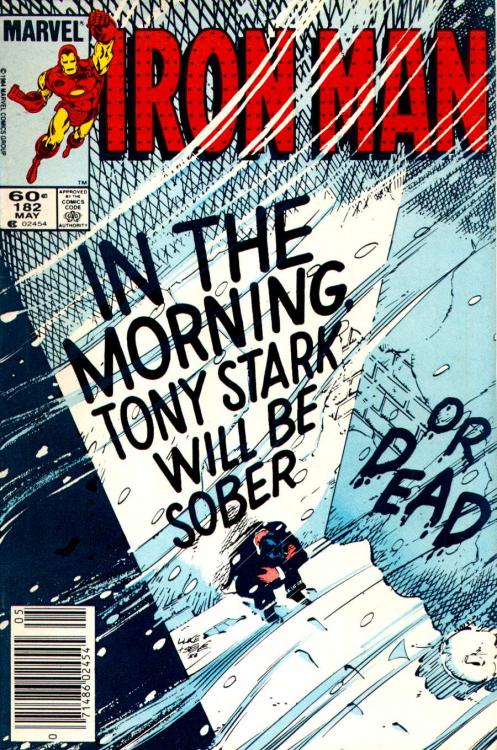
1 pointAfter one of the most steady, spectacular and dynamic runs of all, came one which was possibly the most dramatic and controversial. It was penned by Dennis O'Neil, another legend in his own right, who had a big hand in the beginning of the 'Bronze Age' - the period of comic books writing in the 1970s, when darker, more serious themes were introduced (perhaps more strongly felt over at DC than at Marvel, which, after all, had started out as basically a stable for heroes with problems). O'Neil, himself a recovering alcoholic, has written many memorable superhero stories involving substance abuse. He participated in the legendary "Snowbirds don't fly" Green Arrow/Green Lantern story, with its iconic "My ward is a junkie!" cover, and later wrote "Venom" for Batman, in which the Caped Crusader struggles with addiction to the same substance which, much later, empowers Bane. One wonders if this affected the decision to have him write on 'Iron Man', who after all, a few years earlier, had gone through an emotional alcoholic episode. O'Neil started out his run with an issue straight-out about alcoholism, and you could have thought that'd be the end of it, but he had different plans. Big plans. Stark International came under attack from an unknown source; sabotage, then corporate attack and outright terrorism by bizarre armored operatives known as 'Chessmen' - the Knight who attacked directly, the Bishop who used psychic weaponry and the Rook who employed a series of elaborate traps. Tony Stark suffered more and more pressure and stress as he attempted to root out the source of the attacks, but was comforted by his latest lady-friend, the beautiful Indries Moomji. But when things were at their worst, after weeks of hellish struggling against endless assaults and hunting for his unseen enemy, Moomji cruelly rejected him, revealing she had been toying with him all this time. She was, in fact, the Queen and her final attack proved critical; Tony Stark, having been deliberately tempted with alcohol all this time, finally succumbed and got drunk. And he basically remained drunk for days, while his enemy calmly proceeded with his assault on Stark International using means fair and foul, just as Midas had done years before, but with far more success. The enemy was Obadiah Stane, a man who had worked his way up from poverty through any means, leaving a trail of broken lives, getting richer and more powerful with each step. His approach to success was that of a chess-master; devising long-term strategies and applying an array of different tactics using different pieces at the same time. He took possession of Stark's company, renaming it Stane International and returning to the arms and ammunition trade - at the same time taking steps to ensure Tony Stark would not be able to strike back: he froze Stark's own assets. Tony, now drunk practically all the time, became destitute and resisted all attempts to help him by any of his friends, even the superheroic ones. He ended up a desperate homeless derelict, sleeping in flophouses, drinking dollar-store hooch. What became of Iron Man? Some time before Stane took over, an unrelated crisis struck Stark International, and Tony Stark was unable and unwilling to armor up - so he actually made Jim Rhodes the new Iron Man, and Rhodey extremely reluctantly accepted. The next few months saw Rhodes, the new Iron Man, struggle to fill the role - Tony Stark had had years of experience and knew the exact abilities and limitations of his armor, because he had created it himself. On the other hand, he himself had been a soldier for years before he became a pilot at Stark Industries, and his different approach to Iron Man surprised some of the enemies he faced. He also wasn't without support, as he was helped by genius engineer Morley Erwin, a former Stark employee, and his even-more-genius sister Cassandra; they maintained the armor and helped him learn to control some of its more intricate systems. He even participated in the 'Secret Wars', Marvel Comics' biggest event to that date. In his absence, as he was fighting for the fate of all reality in a distant corner of the universe, Tony Stark's own fate was also determined. He survived. He resolved to stop drinking. And he joined the Erwins and Rhodes as they moved to the West coast to start a new electronics company called 'Circuits Maximus'. Their team evolved into an armored superhero-for-hire (because someone had to pay the bills for their start-up) backed up by an engineering genius triad. The new Iron Man took on and defeated opponents such as the mercenary Flying Tiger, former member of the Wrecking Crew Thunderball, the insane Vibro -who channelled the power of the st.Andreas rift to cause earthquakes- , a new version of the Zodiac's Taurus, Firebrand, who had resurfaced after years of retirement and criminal artist the Termite, whose touch dissolved solid materials. Rhodes was going through psychological stress, however. He found he had become irrationally attached to the armor and was tortured by the idea that Stark would reclaim his position, even though he showed no willingness to do so. In fact Stark felt that being Iron Man played a big part in pushing him towards alcoholism. Things got worse, however, as Stark started to build a new armor for himself, more as a mental exercise than anything else (or so he told himself) and Rhodes felt more threatened; things eventually got to a head as the two men went head-to-head in an Iron Man versus Iron Man duel, which ended with Stark resolving he would never be Iron Man again, and Jim Rhodes seeking counseling to deal with his issues - which, it was revealed, were exacerbated by imperfect calibration of the armor itself. Ironically, the whole matter was solved by none other than Obadiah Stane. Growing worried by the fact Tony Stark had not been outright destroyed, had in fact recovered, he chose to simply have the new company eliminated by means of an old-fashioned bomb. The explosion destroyed Circuits Maximus, killed Morley Erwin and severely injured James Rhodes and Clytemnestra... but left Tony Stark unharmed, as well as fatally determined. Unknown to Stane, he had designed and created a new, superior Iron Man armor, perhaps intending for Rhodes to wear it - but now he donned it himself. He made his way to Stane Industries to confront Stane, only to find that the chessmaster was again employing different strategems to win; he had abducted several of Tony Stark's oldest friends and now held them hostage. But Iron Man managed to free them and take them to safety. Stane responded by sending his Chessmen at him again, but they were brushed aside; and when all of his plans and tactics failed, Obadiah Stane resorted to his final solution: a giant, powered armor based on Iron Man's older designs, perfected by his own engineers. The duel between the Iron Man and the Iron Monger devastated the Stane International campus, but was a very one-sided affair; Stane was no match for the unleashed Stark, and when he realized there was no victory possible, he took his own life, blasting his head off with his own repulsors. The nightmare - the long nightmare, at almost three years - was over; now, Tony Stark had to rebuild. The next few issues were clean-up - for instance, switching back the minds of Bethany Cabe and Madame Masque, whom Stane had had swapped out - as well as restarting a new conflict, namely with the sinister science-terrorist organization AIM, in particular the subversive Yorgon Tykkio. Perhaps to make up for the havoc he had undeniably wreaked, O'Neil's final act as writer on 'Iron Man' was the creation of the Stark space station, which would prove an iconic mainstay in the years to come and the site for some of the most gripping stories ever told in the title. Next, a familiar team returned to Iron Man - Michelinie and Layton, for their second run.
 1 point
 -
1 pointIn 1979, Iron Man belonged to a duo which has gone down in legend and is still believed by some to be the definitive team on the title, and which would take it into the eighties: David Michelinie and Bob Layton. Under their tutelage, Tony Stark became a more James Bond-esque character (there was even some quirky humor), a man of action both in his armor and outside of it. He was more or less constantly under attack, at home, abroad or in outer space - but fortunately, he wasn't alone, as he got a cast of new supporting characters, some as dynamic as himself: James Rhodes, Bethany Cabe and Scott Lang. He'd need their help, too, as he was up against the machinations of both Madame Masque, who had turned to the dark side completely, and Justin Hammer - a new character, and one of Iron Man's most effective and enduring nemeses. There was certainly something of the Bond villain about him - smug, gaunt and gleefully evil, he would have incredibly ostentatious headquarters - floating mansions and gigantic submarines. Hammer never engaged in physical confrontation himself; instead, he employed an army of supervillains to support his evil schemes, while financing their equipment and legal bills when necessary. He managed even to take remote control of Iron Man's armor, framing him for the murder of a man who obstructed his plans. Another opponent was ROXXON, basically an international criminal organization posing as a company - or the other way around. They secretly constructed a gigantic orbiting solar power plant, but when one of its microwave energy transfers went awry, killing an entire midwestern town, Iron Man found himself battling the station's guardian - the awesome, yet tragic Sunturion. Even SHIELD, the secret peacekeeping organization, was trying to take control of Stark Industries by buying up its stock. Besides these grand schemers, Iron Man also had to face the revenge of the Titanium Man, the manic Endotherm and the Living Laser, as well as none other than the incredible Hulk. Coming to Stark for help, Bruce Banner had a heartbeat-controlling device installed, which would control his emotional state, so he would not transform into his raging counterpart again. Unfortunately, the nuclear micro-battery of the device went haywire due to Banner's radioactive metabolism, causing his heartbeat to rise instead - unleashing a more furious Hulk than ever. In the end, Tony Stark managed to knock out the rampaging Hulk, by funnelling all of his suit's power into a single punch - burning out his armor in the process. Apart from these formidable opponents, Michelinie came up with one more enemy for Tony Stark to face, one which was destined to haunt him the rest of his days... From the start of his run, Dave had sown seeds, little remarks here and there on how Tony was drinking maybe a little more than he should. After the first attack by Hammer - which ended with the hero disgraced because, although he was exonerated from the murder, it was still his power which had killed an innocent man - Tony was under great stress. He responded to this by getting drunk; and then Bethany Cabe confronted him about it, explaining how she lost her husband Alex to drugs, and didn't want to watch alcohol do the same to him. In the end, finally recognizing he had a problem, he asked her for help, and after a great struggle, Tony Stark turned his back on booze. This was laid down in the famous issue "Demon in a bottle". The thing is, while Michelinie and Layton did not intend to make a statement, and meant for the alcohol to be the 'villain of the story', it has sort of taken on a life of his own. And not always for the best. Another legendary story in the first Dave and Bob run was Iron Man's battle with Doctor Doom, transported back in time to the days of King Arthur. Doom allied himself with the villainous Morgana le Fay (he still has a transtemporal relationship with her to this day), and headed an army of the living dead to meet on the battlefield with Iron Man and the Knights of the Round Table. The very focused and together tone of the run - of a little over three years - made it probably the very best one until then ands well as one of the best on 'Iron Man' of all time. However, all good things must come to an end, and this one was about to give way to another legendary run - although one which is less universally lauded.
 1 point
 -
1 pointStan Lee and Archie Goodwin (who died, much too young, in 1998) are both legends, in a way - monuments of writers and editors, as I like to call them: 'Giants of old, men of renown'. They were succeeded by what I shall unkindly call 'lesser gods' - Allyn Brodsky, (not-so-lesser, although this was hardly his best work) Gerry Conway, Mike Friedrich and Bill Mantlo, as well as shorter efforts by Len Wein, no-relation Gary Friedrich and Steve Gerber, and single issues by Robert Kanigher, not-hardly-lesser-gods Jim Shooter and Roy Thomas (Both, like Archie and Stan editor-in-chief at Marvel in various periods) and M.Gold. Until today I didn't actually know who M. Gold is, but it turns out it's actually Mimi Gold, the only woman who has ever written any issue of the Iron Man series*. It wasn't bad, either. In any case, these were the men - and woman - who wrote Iron Man through the 1970s. While not legendary runs, there were certainly enjoyable stories, as well as the on-going addressing of changing social attitudes. Bill Mantlo's first issue, for instance, was a flashback issue to the Vietnam days which offered a considerable reassessment of that situation - as well as the outright statement that Tony Stark was no longer manufacturing weapons for the United States armed forces. Not all was great. Gerry Conway's short run was a confused mess revolving around Marianne Rogers, Tony Stark's aformentioned love interest, and her struggle with her psychic powers. The character was frankly outrageous by modern standards (but then, this was 1971); she was an emotionally unstable, wide-eyed mess who was constantly given the role of the damsel in distress, until Tony told her in no uncertain terms to just get out of his life. That particular ball was picked up much later by another writer. Also in this run was the development of the character Michael O'Brien, a comically Irish sidekick to Tony, who eventually took up the powered armor of Guardsman; only for it, and a rivalry over the love of Marianne Rogers (honestly, that woman was a vortex of trouble) to drive him to madness and death. Next up was Mike Friedrich, who lost no time in having Marianne go completely nuts with terrifying hallucinations sending her into a psychosis, so she was institutionalized (an early form of 'being stuffed in the fridge', as Gail Simone calls it). This freed up Iron Man to deal with something which could have been awesome, but instead turned out to be one of the classic comic book failures of all time: The War of the Supervillains. This 'War' was more like a contest: it started when a mysterious, sinister being calling himself 'The Black Lama' offered all the most powerful supervillains in the Marvel Universe the 'Globe of Power', a device which he claimed would bring them inner peace and with it, the strength to fulfill their goals. But only one of them could claim the globe, and they had to fight all the others for it. Now, a power struggle between all the most powerful supervillains of the Marvel Universe (even in the early Seventies) would have made for a hell of a crossover. Unfortunately, the whole thing was a mess - it was drawn out over more than two tears, there was no real build-up, and the conclusion was unbelievably lame - it turned out, after a LOT of drama, that the Black Lama was from an alternate dimension, his exile in the Marvel Universe had affected his mind, and after his return he had nothing more to offer than "Sorry, I acted a little crazy back there". Also, and rather more important to the Marvel Universe as a whole, Friedrich's run featured one single issue co-written by Jim Starlin which introduced two important characters: Drax the Destroyer, and the being whose nemesis he was created to be: Thanos. It was a humble beginning for the villain who is probably the worst and deadliest menace in Marvel Comics. Anyway, after a few substitute teachers delivered some fairly solid stuff, Bill Mantlo finally took over and, after first reintroducing the Mandarin, told a nice, dare I say epic tale involving Mordecai Midas, Madame Masque and Marianne Rogers. Midas, as it turned out, had been maneuvering behind the scenes for years to take possession of Stark Industries as he had before, but this time, he succeeded through mass bribery, stock manipulation, outright theft and extortion. For a while, he reigned like a king over his new realm, having taken possession not only of the industrial empire but also of several Iron Man armors. Meanwhile, Marianne Rogers had been released from mental hospital (where she had been stuck for over 50 issues) and was gradually making her way back to Tony Stark in a complete psychosis, fully intending to kill him with her escalating mental powers. She finally found him during his ultimate confrontation with Midas - who had turned six of Tony Stark's closest friends including Madame Masque, his present love interest, into golden statues - but her attack, rather than destroying Tony Stark, instead struck Mordecai Midas, seemingly erasing his mind, leaving him a mental vegetable. It was pretty heavy stuff - the former helpless perpetual victim turned into a deadly angel of vengeance - but unfortunately the strain left her in a permanent delusional state again. Back into the refrigerator she went. After this, there was not much more to tell - except a story which led to Tony Stark losing the love of Madame Masque, something from which that character has never recovered. A new age was about to dawn. The Eighties were coming, and they would be heralded in by a writer who is still held by many as the definiteve writer of Iron Man, and who would write one specific issue which might be the most influential and damning of all stories... * Mimi Gold is indeed the only female writer who has ever written on the main Iron Man series, and it would be 41 years before two others each contributed one issue each to an Iron Man miniseries, namely Jen Van Meter and Louise Stevenson, who wrote issues 2 and 3 of 'Iron Man: Iron Age'.
 1 point
 -
1 pointStan Lee was actually a pretty classical writer, in his way. In a sense, he is a man from a different era - he was 18 when the second World War began, he was an office hand and writer during the Golden Age of comics (He even wrote for the army) and created Iron Man when he was 41 years old. He belonged to the Greatest Generation, and this inevitably affected the heroes he created and how he wrote for them. Now, as Iron Man finally got his own title, as opposed to appearing in Tales of Suspense, the comic was taken over by younger men - specifically Archie Goodwin, and Iron Man entered a different age, too. These were the late sixties, and the counterculture which had been growing was starting to truly bloom. Iron Man was no longer necessarily a part of the establishment; and the hero's double identity offered the opportunity to express this in a unique way; while Tony Stark remained thoroughly the genius inventor / industrialist / playboy, Iron Man was perceived as a blue-collar worker in employ of Stark Industries and behaved and spoke this way, too. Social issues and the clash between people who wanted to reform society and, usually, Stark Industries, featured heavily - and usually, Tony Stark and Iron Man were caught between the parties, with his sympathies leaning towards change for the better. Apart from this, there was also room for action, superheroism and even the outright kooky. Goodwin was responsible for the creation of several of Iron Man's most memorable enemies, such as the Controller, who enslaved the minds of people and leeched their power, giving his paralyzed body super-strength; Firebrand, who claimed to be a rebel fighting against a rotten system, but in fact seemed more interested in using his flame-throwing powered armor to create mayhem and chaos; the new Crimson Dynamo who infiltrated Stark Industries to seek revenge for the death of his mentor, but ended up falling in love with the same woman as Tony Stark; the mysterious Spymaster - a cipher who deals in information, assassination and sabotage, and whose true face and identity remain a mystery until the present day; Madame Masque, who had a long and complicated love/hate relationship with both Tony Stark and Iron Man, and wore a golden mask to hide her terribly scarred face; and would-be ruler of the world Mordecai Midas - ostensibly the richest man in the world, so fat he could not rise from his hovering, weaponized throne, and for his home had a palace that literally floated in the sky. The greed-consumed Midas had designs on Stark Industries, and his machinations had a most unexpected consequence: Once, Tony Stark had created androids which were indistinguishable from humans; these Life Model Decoys, which were limited in their actions, served to protect specific individuals from attacks. Tony had once used an LMD to safeguard his dual identity by having it pose as himself, while appearing as Iron Man at the same time. Sabotage by order of Midas, however, caused a power surge, and shocked the LMD into life - causing it to take over Tony Stark's life, having him thrown out into the street, even taking over as Iron Man for a short time, until it was destroyed in a final confrontation with its creator. This story would have an echo in Iron Man comics many years down the line. This run of comics also featured Tony Stark's first official girlfriend, Janice Kord; she came to a tragic end without ever even finding out he was also Iron Man. This was the first manifestation of a sinister phenomenon in Tony Stark's life - it is outright dangerous to be the woman he loves. This would also be learned by Marianne Rogers, a young woman with tremendous psychic powers which unfortunately only brought her misery.
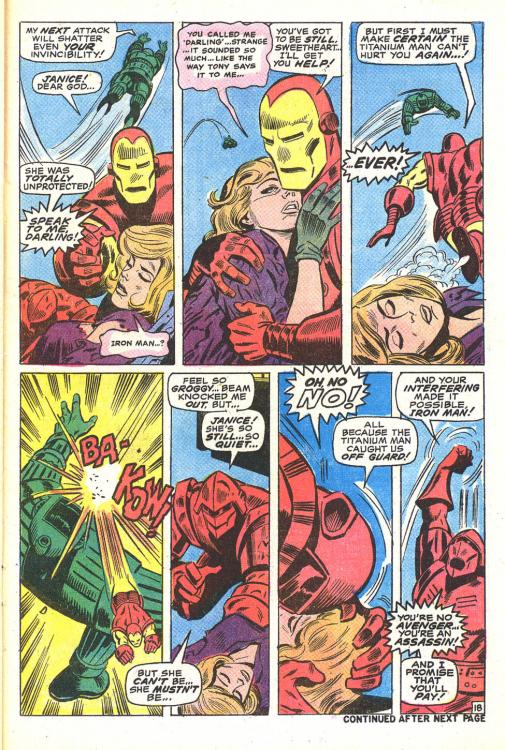 1 point
 -
1 pointSo, Iron Man was born. Now he had to find his feet. Stan Lee outright did not have much experience yet with superheroes. Assuming he wasn't going to emulate DC - as mentioned before - he was prospecting some fairly unknown ground. This shows in the early stories of the new series. Iron Man, at first, did not have his own magazine - instead, he appeared in an anthology book known as Tales of Suspense, which published science fiction, mystery and fantasy, and was one of a slew of such books on sale at the time. Ant-Man and Thor both first appeared in similar magazines. So early on, Iron Man stories took aboard some of the (outrageous) science fiction elements of such stories, but now centered them around the exploits of a troubled but dashing hero. Elements included mad scientists, alien invasions, dangerous technologies in the hands of criminals and ancient, lost civilizations; even outright magical elements were not shunned. There was also, very emphatically, the Cold War as a motif. Many of Iron Man's early enemies were Communist spies, saboteurs or assassins, typically portrayed as absolute caricatures; I have always wondered whether Stan was playing to the audience, or whether it was intended as a satire of propaganda. Almost from the start, also, there was the growing into a shared universe with the rest of Marvel's growing stable of superheroes; some of them even debuted in Iron Man stories, notably Hawkeye and the Black Widow - although still as a fur-wearing classic femme fatale rather than a deadlier version of Catwoman. Eventually, the deal was sealed, so to speak, in the first issue of 'Avengers'. From now on, Iron Man was a member of Marvel's primary superhero team, and Tony Stark would bankroll their base, hardware and transportation. Many of the stories from this early age play with Tony Stark's relationship with Iron Man as he tries to keep his double identity a secret from even his closest friends and allies. Apart from the superheroic element, those friends mainly include Pepper Potts, his loyal secretary, and Happy Hogan, his driver and ostensibly body guard. Things develop into a love triangle - Pepper is in love with Tony Stark, who gradually develops feelings for her, too, but he feels he can't enter into a relationship; while Happy Hogan's in love with Pepper, but feels she could never fall for a rough-around-the-edges ex-pug like him. At the same time, Tony Stark frequently attracts women who usually bring their own batch of complications with them (Such as aformentioned Black Widow, Kala, the queen of the Netherworld, and Cleopatra, the queen of Egypt). Many of Iron Man's most enduring enemies first appear in these early stories - Blizzard (albeit as Jack Frost); the Crimson Dynamo; the Melter; the Titanium Man; the Unicorn; Whiplash; lumbering tower of terror Ultimo, and naturally, the Mandarin. The Mandarin is Iron Man's arch-nemesis. He's Chinese, but no Communist; rather, he is a warlord who is enemy to anyone and intends to one day rule the world. He wields the technology of a distant alient planet thousands of years more advanced than our own, and ten rings of power, each of which possesses another deadly ability; while he, himself, is one of the greatest martial artists in the world. Unfortunately, he's also rather caricaturally Chinese - cast in the same mold as, say, Fu Manchu. Still, he's a classic, who made several appearances in the Stan Lee run of Iron Man, which lasted until 1968. (to be continued...)
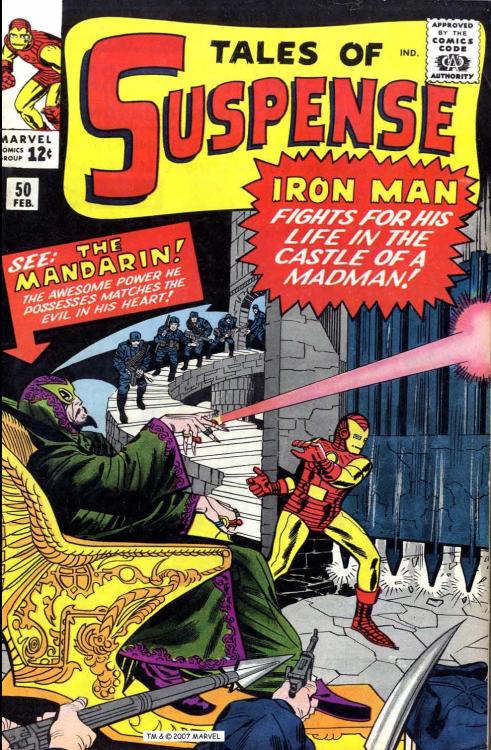 1 point
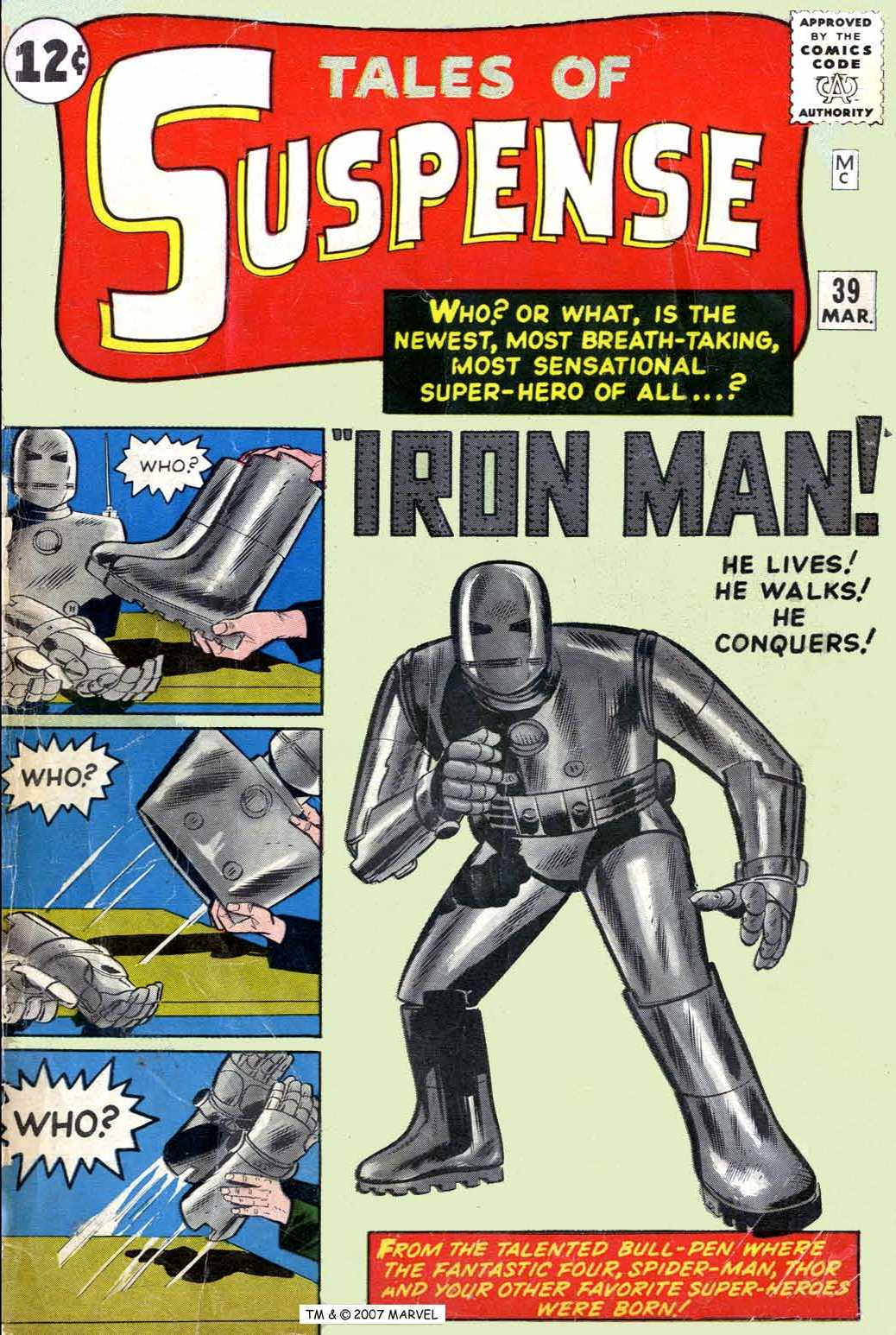


.jpg.b15c3734a97f170d2aaa025e6c334f21.jpg)


