Leaderboard
-
Salkafar
Member++2Points1,339Posts
Popular Content
Showing content with the highest reputation on 11/07/2016 in all areas
-
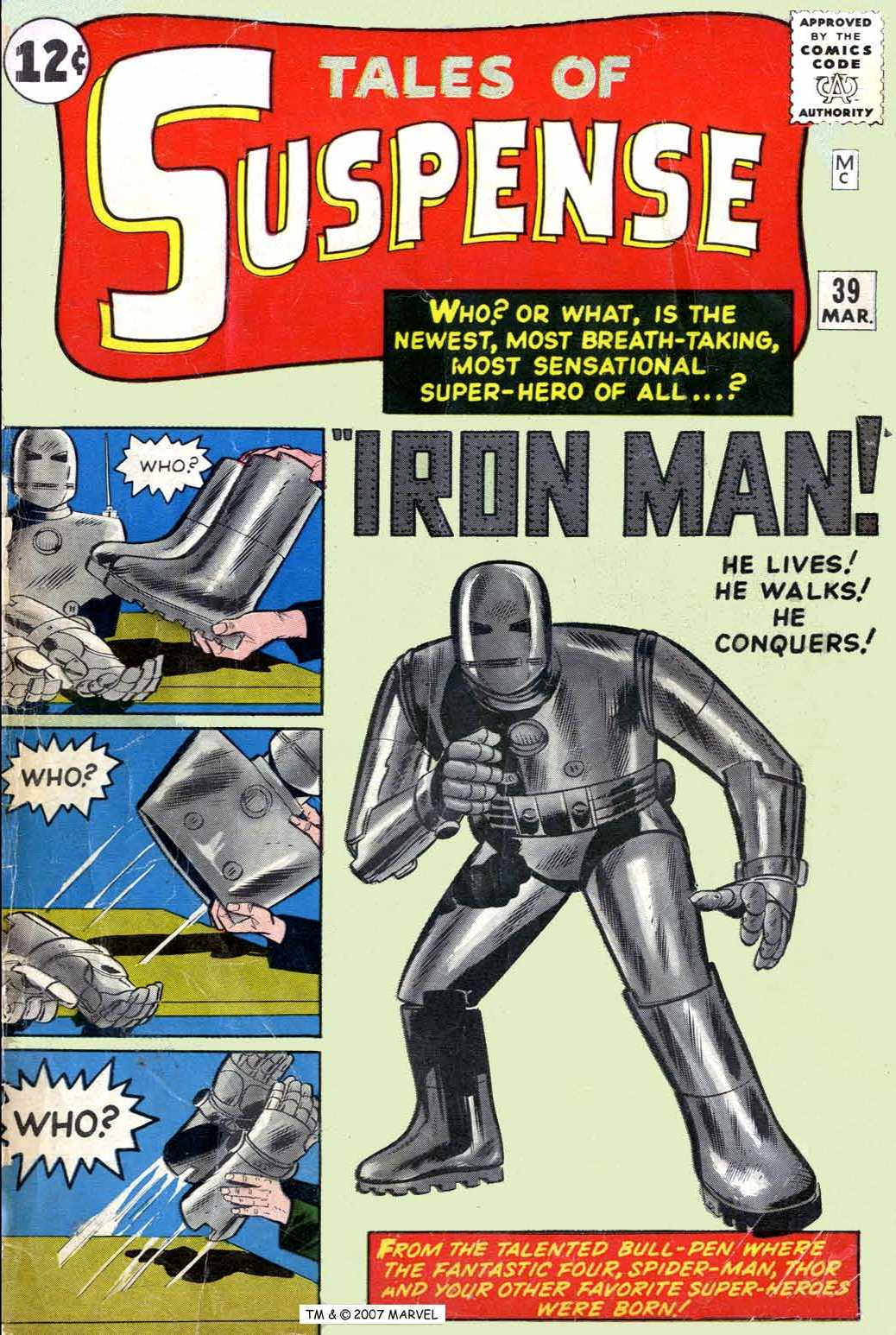
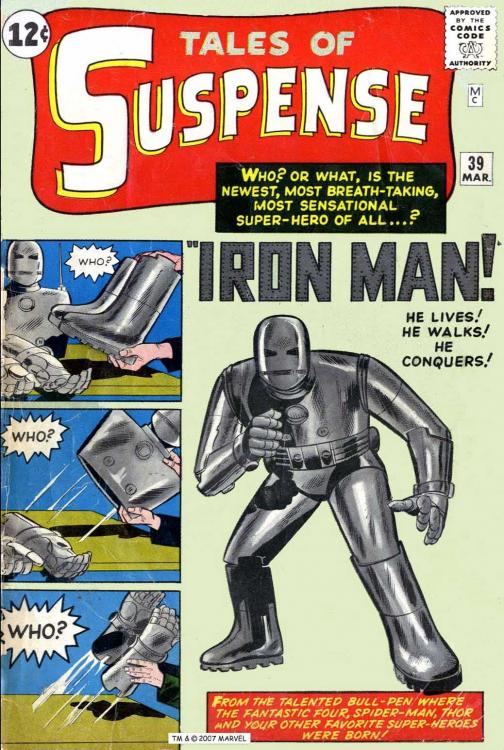
1 pointYeah, I thought it was time for a thread devoted to my favorite American armored superhero. He is so very different from Sho Fukamachi. And yet, I have the feeling they would get along very well if they ever met. So... who is this guy, anyway? And where did he come from? Okay. Set the scene. It's 1963. Marvel comics has been publishing superhero comics now for a few years and things are going fine. The publishing house sets itself apart from DC, the company that invented the 'cape' genre, by having heroes that a) didn't wear capes (except for Thor, but he gets a pass because he's, like, two thousand years old) and b) had to deal with crap like everybody else. Now, over at DC, the superheroes were generally viewed with awe and admiration by the average upstanding citizen of, say, Metropolis or Gotham City. By this time, even Batman was family-friendly. It was all pretty much squeaky-clean. So, Stan Lee decided not to go that way. Instead, he created heroes that were quirky. They had issues. They weren't 'spit-curled demi-gods'. Now, in 1963 the Marvel stable of heroes was still so small you could comfortably accomodate them in a roadside diner; they consisted only of the Fantastic Four, a loving but dysfunctional family of misfits who received their powers in a disastrous accident; Ant-Man, a dejected scientist who invented a size-changing formula which he initially decided to throw out and never use again after he was almost ripped to pieces by ants; Thor, an actual god whose alter ego / secret identity was a crippled, timid medical doctor; the Hulk, a mild-mannered, physically frail scientist who designed the deadliest weapon ever created, almost got killed by it, and was periodically transformed into a giant, super-strong brute with an enormous chip on his shoulder and zero impulse control; and Spider-Man, a teenager who received super-powers from being bitten by an irradiated creature famed for being creepy, and whose life apart from superheroics was basically a chain of unfortunate events. They didn't get victory parades or autograph signings; they got into legal trouble and had scathing articles written about them in the papers. Where to go next? Stan Lee decided that after creating these counter-culture heroes - unbridled youngsters, world-weary scientists and god-like lumbering warriors, he'd create a guy the young people he wrote for would have to hate. And then make them like him. Enter Anthony Stark. A wealthy - okay, multi-millionaire - socialite, born to an established New York upper-class family, the son of an industrialist, lives in a Manhattan mansion, a playboy, always in well-cut suits with a martini in one hand and a debutante on his other arm. And how did he make his money? By designing and making weapons and ammunition and selling them to the US government. This in 1963. The Cold War was at its peak. The Cuban missile crisis had happened less than a year before. President Kennedy had recently escalated military activity in Vietnam. Anti-establishment feelings were strong among the youth of the USA, and here Marvel Comics presented this almost ultimate establishment character as a new superhero. Ballsy move. How do you make such a guy likable? You put him through Hell. The story goes like this: Tony Stark is in Vietnam, demonstrating his new technology for the US military and observing weapons designed for him in use. However, in the jungle, he runs into a booby trap and is taken captive by enemy soldiers working for a Communist commander named Wong Chu. Wong Chu, a brute who takes delight in challenging people in the villages he conquers to a wrestling match, promising freedom if he is defeated - which he never is - recognizes Tony Stark as a top weapons designer. His surgeon tells him Stark has deadly shrapnel in his body which cannot be removed, and has at most a week to live. Wong Chu convinced Stark to make a weapon for him in return for the promise of life-saving surgery, smirkingly noting that the industrialist is all-too ready to betray his country. However, Tony Stark realizes no such surgery is possible, and intends to trick Wong Chu by building a system which will save his life and help him escape at the same time. He is soon joined by another prisoner, aged Ho Yinsen, a famous scientist in his own right who had been abducted by the Communists to work for them. Together, the two men build Stark's design of a powered armor which will keep his heart beating even after the shrapnel reaches it. Even as the armor is completed and Tony Stark, on the brink of death, is sealed inside it as it is calibrating, Wong Chu approaches to check on his progress. To buy Stark time, Ho Yinsen rushes out of their hut, screaming and running and throwing quite a ruckus, until Wong-Chu has him shot. Inside the hut, they find no trace of Tony Stark; he is hiding himself on the ceiling, using suction cups to stay up, and is momentarily subject to despair as he realizes he can never take the armor off again, or he will die. Moments later, the Communists are confronted by a hulking metal man who resists all their weapons and challenges Wong Chu, swiftly defeating him. The Communists flee, and as Wong Chu himself runs, Iron Man manages to detonate an ammunitions storage, seemingly killing his captor. Having thus avenged Ho Yinsen, Tony Stark walks into the jungle inside his super-strong iron prison, wondering what the future will hold for him. It's just 13 pages, written in thoroughly outdated prose and with some alarmingly racist undertones - the Communists are all saffron-yellow and speak broken English even among themselves - but it certainly does the job of introducing the hero of the piece, and his predicament. Like I said, Stan Lee liked his heroes to have some fairly crippling flaw to deal with, and Tony Stark kind of had a double whammy: he was an establishment arms-dealer during the Vietnam war who was practically cut off from all the benefits of his wealth and good looks, because of the demands of his metal chest plate (turns out he didn't have to wear the full armor - but he couldn't take off the chest piece, and he had to keep it charged, or he'd outright keel over and die in minutes). Maintaining a dual identity - glamorous, intellectual rich boy Tony Stark and stolid, heroic, almost inhuman Iron Man - also took its toll. He could have lady friends, but not a sexual relationship, because then his secret would be out - assuming he could even perform in his current condition, let alone the lady in question. For better or for worse, Iron Man was born. To be continued...
 1 point
 -
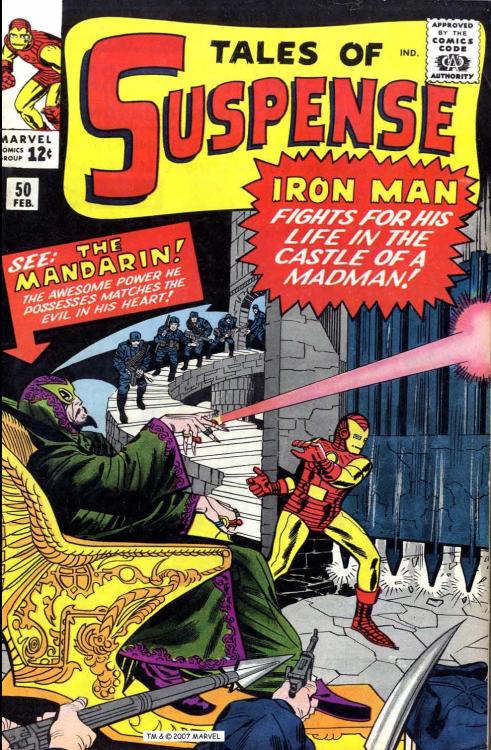
1 pointSo, Iron Man was born. Now he had to find his feet. Stan Lee outright did not have much experience yet with superheroes. Assuming he wasn't going to emulate DC - as mentioned before - he was prospecting some fairly unknown ground. This shows in the early stories of the new series. Iron Man, at first, did not have his own magazine - instead, he appeared in an anthology book known as Tales of Suspense, which published science fiction, mystery and fantasy, and was one of a slew of such books on sale at the time. Ant-Man and Thor both first appeared in similar magazines. So early on, Iron Man stories took aboard some of the (outrageous) science fiction elements of such stories, but now centered them around the exploits of a troubled but dashing hero. Elements included mad scientists, alien invasions, dangerous technologies in the hands of criminals and ancient, lost civilizations; even outright magical elements were not shunned. There was also, very emphatically, the Cold War as a motif. Many of Iron Man's early enemies were Communist spies, saboteurs or assassins, typically portrayed as absolute caricatures; I have always wondered whether Stan was playing to the audience, or whether it was intended as a satire of propaganda. Almost from the start, also, there was the growing into a shared universe with the rest of Marvel's growing stable of superheroes; some of them even debuted in Iron Man stories, notably Hawkeye and the Black Widow - although still as a fur-wearing classic femme fatale rather than a deadlier version of Catwoman. Eventually, the deal was sealed, so to speak, in the first issue of 'Avengers'. From now on, Iron Man was a member of Marvel's primary superhero team, and Tony Stark would bankroll their base, hardware and transportation. Many of the stories from this early age play with Tony Stark's relationship with Iron Man as he tries to keep his double identity a secret from even his closest friends and allies. Apart from the superheroic element, those friends mainly include Pepper Potts, his loyal secretary, and Happy Hogan, his driver and ostensibly body guard. Things develop into a love triangle - Pepper is in love with Tony Stark, who gradually develops feelings for her, too, but he feels he can't enter into a relationship; while Happy Hogan's in love with Pepper, but feels she could never fall for a rough-around-the-edges ex-pug like him. At the same time, Tony Stark frequently attracts women who usually bring their own batch of complications with them (Such as aformentioned Black Widow, Kala, the queen of the Netherworld, and Cleopatra, the queen of Egypt). Many of Iron Man's most enduring enemies first appear in these early stories - Blizzard (albeit as Jack Frost); the Crimson Dynamo; the Melter; the Titanium Man; the Unicorn; Whiplash; lumbering tower of terror Ultimo, and naturally, the Mandarin. The Mandarin is Iron Man's arch-nemesis. He's Chinese, but no Communist; rather, he is a warlord who is enemy to anyone and intends to one day rule the world. He wields the technology of a distant alient planet thousands of years more advanced than our own, and ten rings of power, each of which possesses another deadly ability; while he, himself, is one of the greatest martial artists in the world. Unfortunately, he's also rather caricaturally Chinese - cast in the same mold as, say, Fu Manchu. Still, he's a classic, who made several appearances in the Stan Lee run of Iron Man, which lasted until 1968. (to be continued...)
 1 point